


I recently watched an engineering team spend three weeks trying to perfect a 2,000-word prompt. They were building a fragile glass tower. Every time the underlying model updated, their prompt broke and the output failed. They were stuck in the prompting trap, assuming that better adjectives would solve their reliability issues.
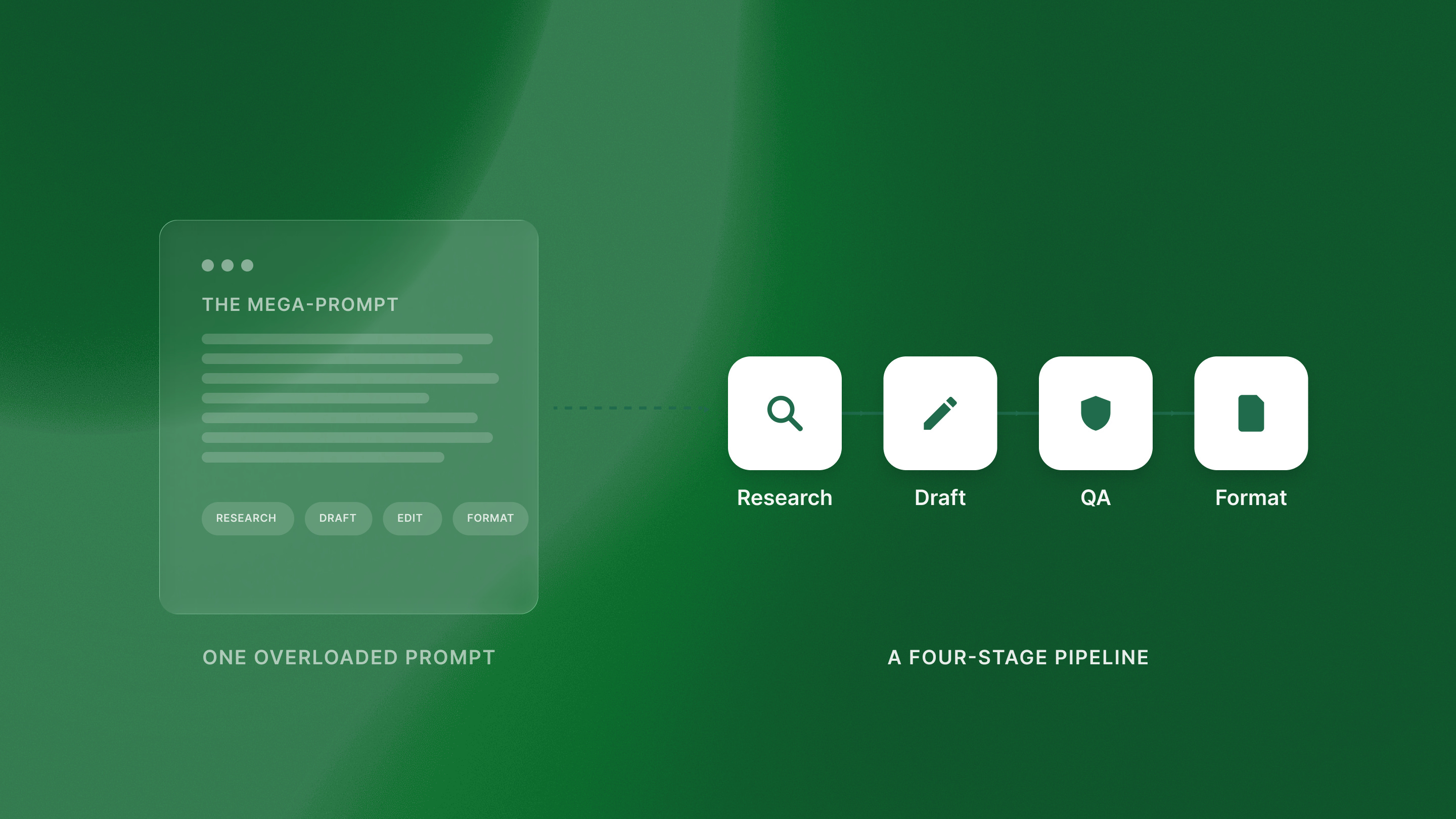
AI content automation requires architectural rigor. If your strategy depends on a good human prompt, you built a digital intern, not an autonomous system. To achieve scale, you must move from manual prompting to automated agentic pipelines. This transforms content from a high-overhead chore into a compounding technical asset.
Scaling with AI content automation
The pricing landscape for content has shifted toward infrastructure. There is a hard divide between teams that use AI to write and teams that use AI to build. The market is shifting toward a model that prioritizes the orchestration layer over the drafting phase. Developing a pipeline architecture ensures each stage of the content lifecycle is handled by a specialized model. It avoids using one overloaded prompt for everything.
Content pricing shifts
Shift from per-word pricing toward per-workflow or per-agent models
High premiums for integrated business logic and automated QA layers
Increased investment in GEO expertise to capture visibility in AI search engines
Tiered pricing based on the complexity of the orchestration layer
Why single-prompt workflows fail at scale
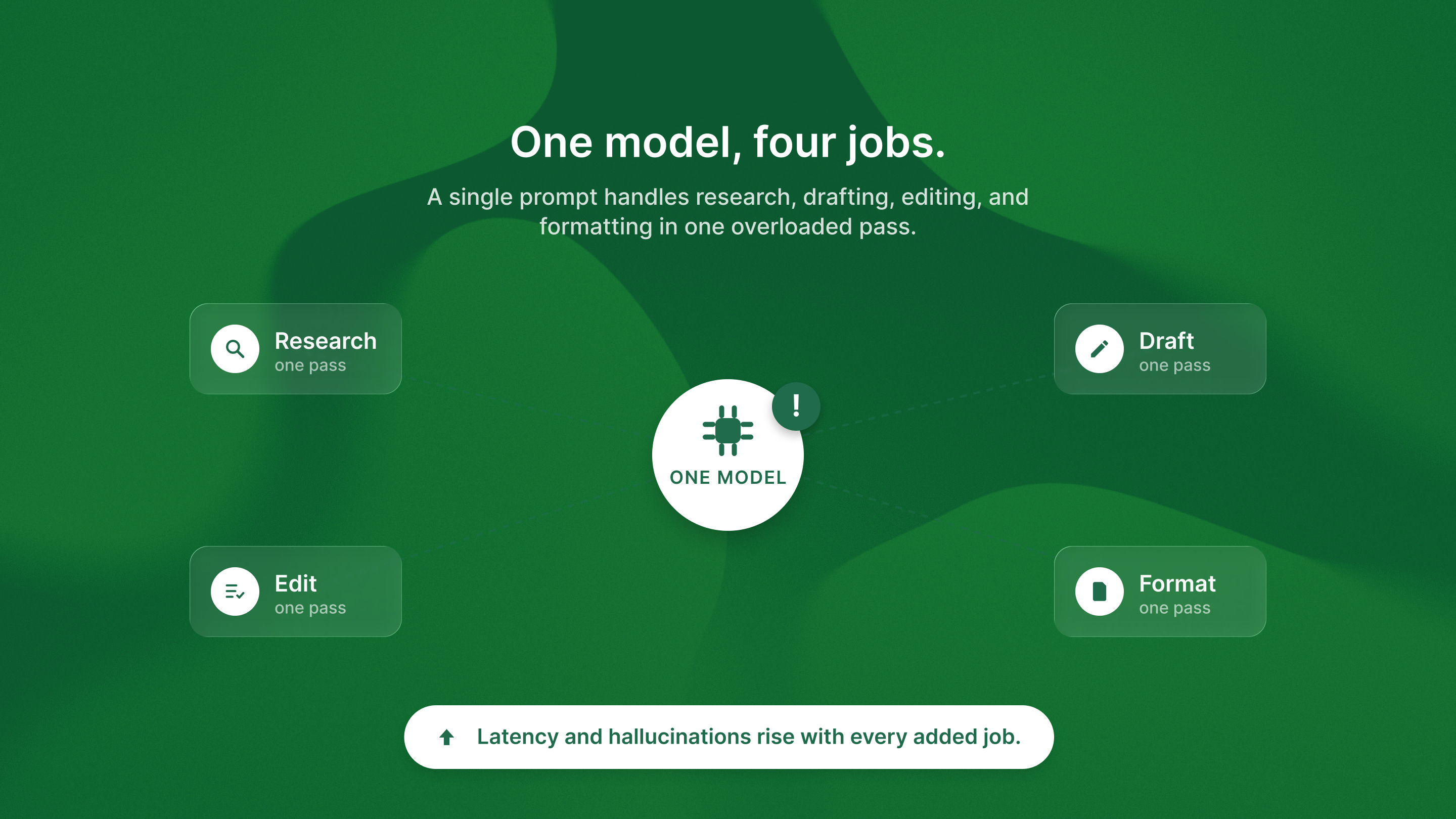
Single-prompt workflows are inherently fragile. They are prone to hallucinations because one model handles research, drafting, and editing in a single pass. This creates a massive latency and hallucination tax. Your team spends more time fixing AI mistakes than they would have spent writing the content from scratch.
The latency and hallucination tax
When a model processes too much information at once, its accuracy drops. In a content environment, this means it might invent facts or miss brand nuances. It might also fail to follow technical constraints. Many organizations struggle with reliability because they prioritize surface-level prompts over production-grade infrastructure. Deploying production-grade AI agents allows you to isolate these failures and maintain standards across thousands of assets.
The architectural trap of better prompting
The trap is thinking that you can prompt your way out of a systems problem. No matter how good your prompt is, it cannot replace a multi-stage pipeline. A pipeline allows for error boundaries and state management.
Joe Armstrong built Erlang around this idea and reduced its whole fault-tolerance philosophy to a single instruction:
“Let some other process do the error recovery.”
Joe Armstrong — Erlang error-handling philosophy
His reasoning was that you cannot make a system fault-tolerant with only one process. If that process fails, nothing is left to notice. Trying to make one component predict every failure creates defensive code. That code is fragile in another way. A single prompt is one process. It has no supervisor, no boundary, and no second component watching to catch the failure and retry. That is not a prompting weakness. It is a topology with no room for recovery in it. These are essential for autonomous agentic systems. Most content automation today is just faster manual writing that lacks the necessary guardrails for scale.
The pipeline architecture: Research, draft, and QA flow
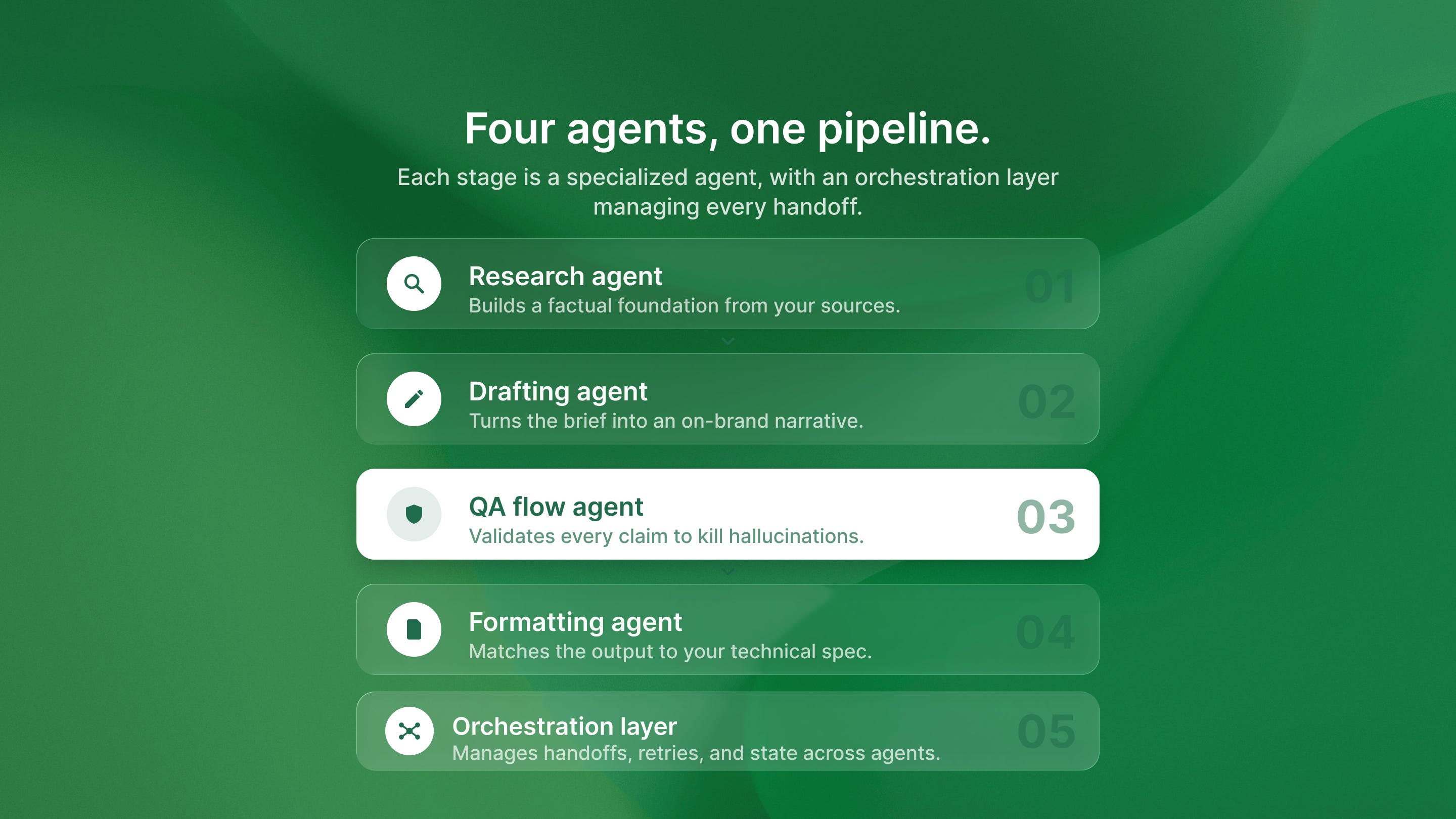
Modern AI design involves treating agents as distinct users within a system. Instead of one prompt, you build a multi-stage pipeline where concerns are separated. This is the agentic loop. Implementing AI workflow orchestration synchronizes these distinct steps into a unified, reliable output. We structure these pipelines for reliability using these components:
The Research Agent: Focused solely on ingesting expert conversations from internal sources to extract technical insights.
The Drafting Agent: Uses the research output to create a structured narrative based on your specific brand voice.
The QA flow Agent: Validates the draft against technical requirements, checking for hallucinations and ensuring formatting is correct.
The Orchestration Layer: Manages the handoffs between these agents and handles any retries or errors in the process.
Lessons from the field: QA flow and integrated workflows
We have seen this work in production with sustainable LinkedIn workflows that automate complex social tasks. By separating drafting from scheduling and validation, you ensure the final output is always brand-compliant. Integrating QA flow automation into your stack adds a validation layer.
It acts as a safety net (QA flow). This prevents broken content from reaching the end user.
Building for agentic UX
Agentic UX is the discipline of designing for agents as distinct users within a specialized pipeline architecture. According to Medium, this requires designing for AI agents as distinct users rather than just human end-users. It moves the human from being the primary writer to being the supervisor. This requires interfaces that show the pipeline’s progress. They also allow intervention if an agent goes off track. A hybrid AI content architecture ensures that while agents handle data synthesis, human oversight maintains compliance.
Your 30-day pipeline roadmap
To stop prompting and start building, follow this transition plan:
Identify your most time-consuming content task and break it down into three distinct sub-tasks.
Build a standalone agent for the research phase of that task.
Create a second agent that takes the research output and generates a rough draft.
Implement a validation agent that checks that draft for specific technical errors.
Link these agents together with an orchestration layer to create your first autonomous pipeline.
The bottom line
Shift to pipelines to create a compounding asset. Stop trying to write the perfect prompt and start building the system that operates without one. Reach out for a system audit to map your transition from prompts to pipelines.
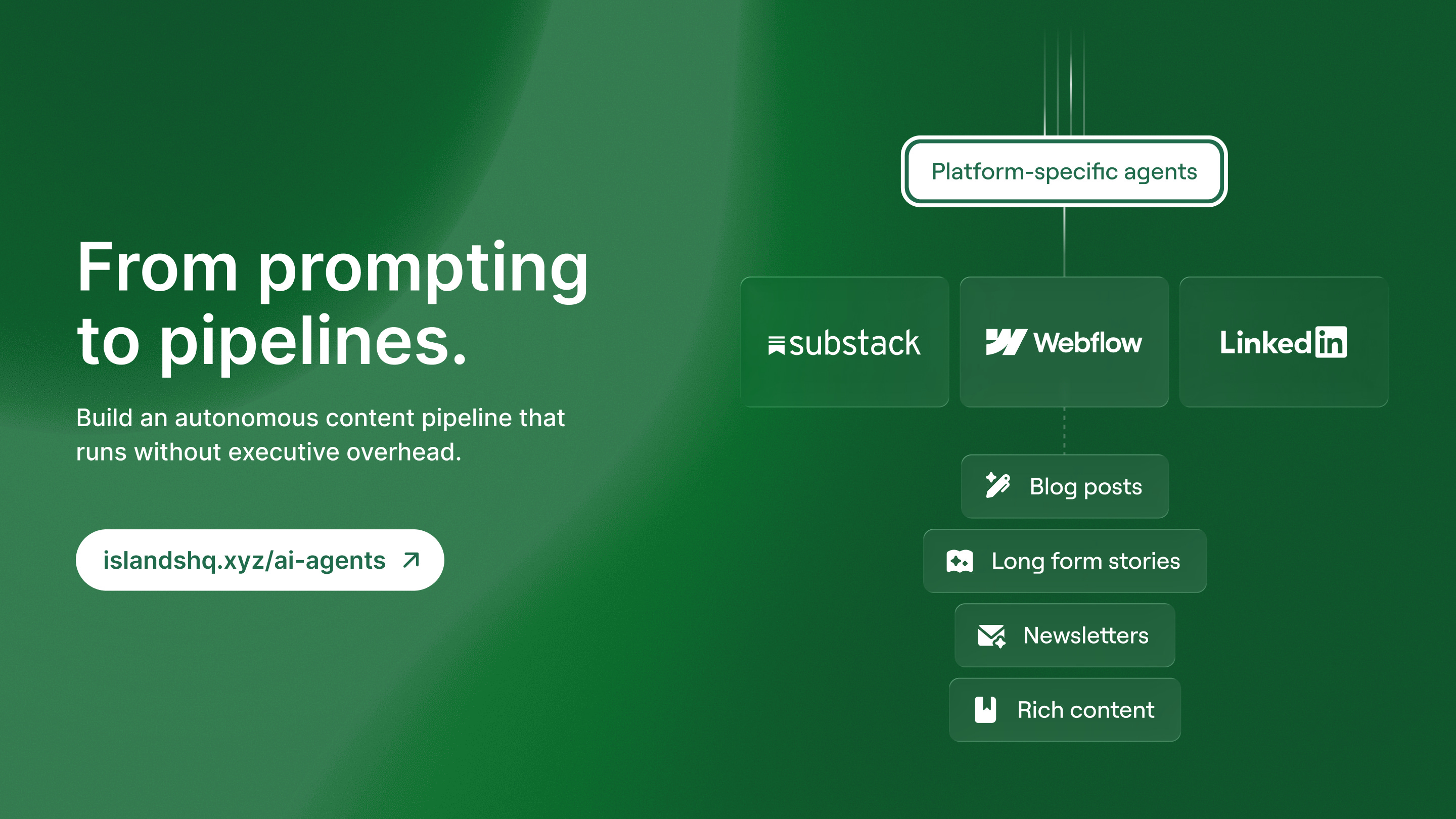
Ready to scale your operations? Book a call with Islands today to build your custom agentic pipeline.