


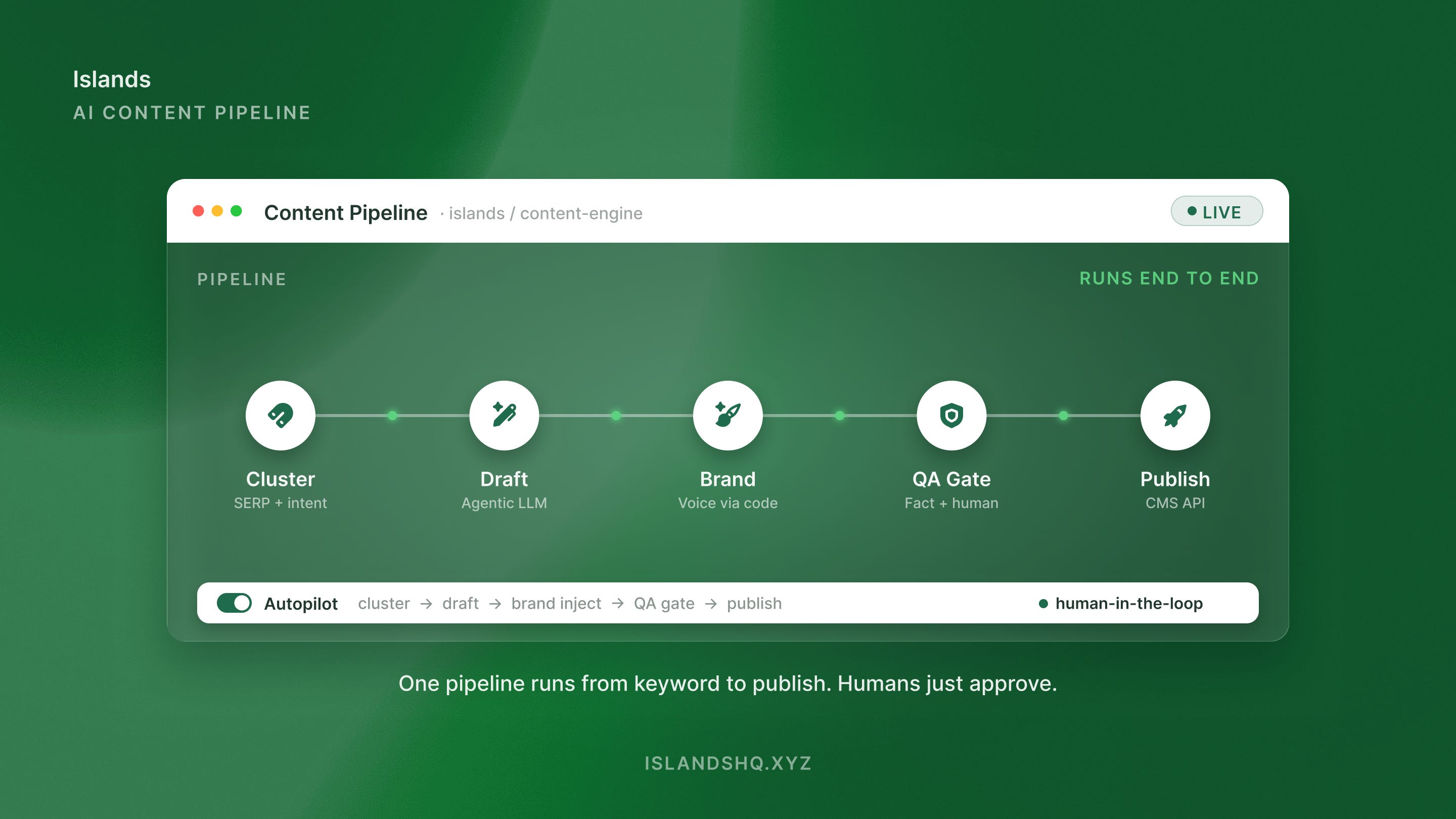
I watched a Series B marketing team spend 15 hours a week fixing AI drafts — they thought they were ahead with a library of complex prompts, but a senior editor was rewriting 70% of every output. That’s not scaling; it’s a new kind of edit tax. The only way out is to treat AI content automation as a systems problem, not a prompt library.
Growth-stage startups that treat AI as a writing assistant are making a strategic error. Scaling organic growth means replacing one-off ChatGPT prompts with programmatic, multi-stage agentic pipelines. Build those with custom agentic scripts, not brittle prompt libraries.
Key takeaways
The Demo Trap: Single-shot prompting inflates the edit tax and kills scalability.
Pipeline Architecture: Production systems need linear trunks for research and quality forks for human review.
Programmatic Voice: Frameworks like LangChain inject brand voice consistently without fragile prompt instructions.
Efficiency Gains: Well-engineered pipelines cut production from 10 hours to under 90 minutes per post.
The prompt-based bottleneck: why your AI content automation isn’t scaling
Most technical founders fall into the “Demo Trap.” Generating a single impressive blog post with a clever prompt is easy. But that success rarely translates to 50 posts a month. Rely on single-shot prompting and the AI defaults to generic, repetitive outputs — no specific examples, no authentic voice, nothing that ranks.
That creates a bottleneck. Time saved in drafting disappears during review. We see teams spending 10 hours per article because the initial AI draft is essentially a hallucination skeleton.
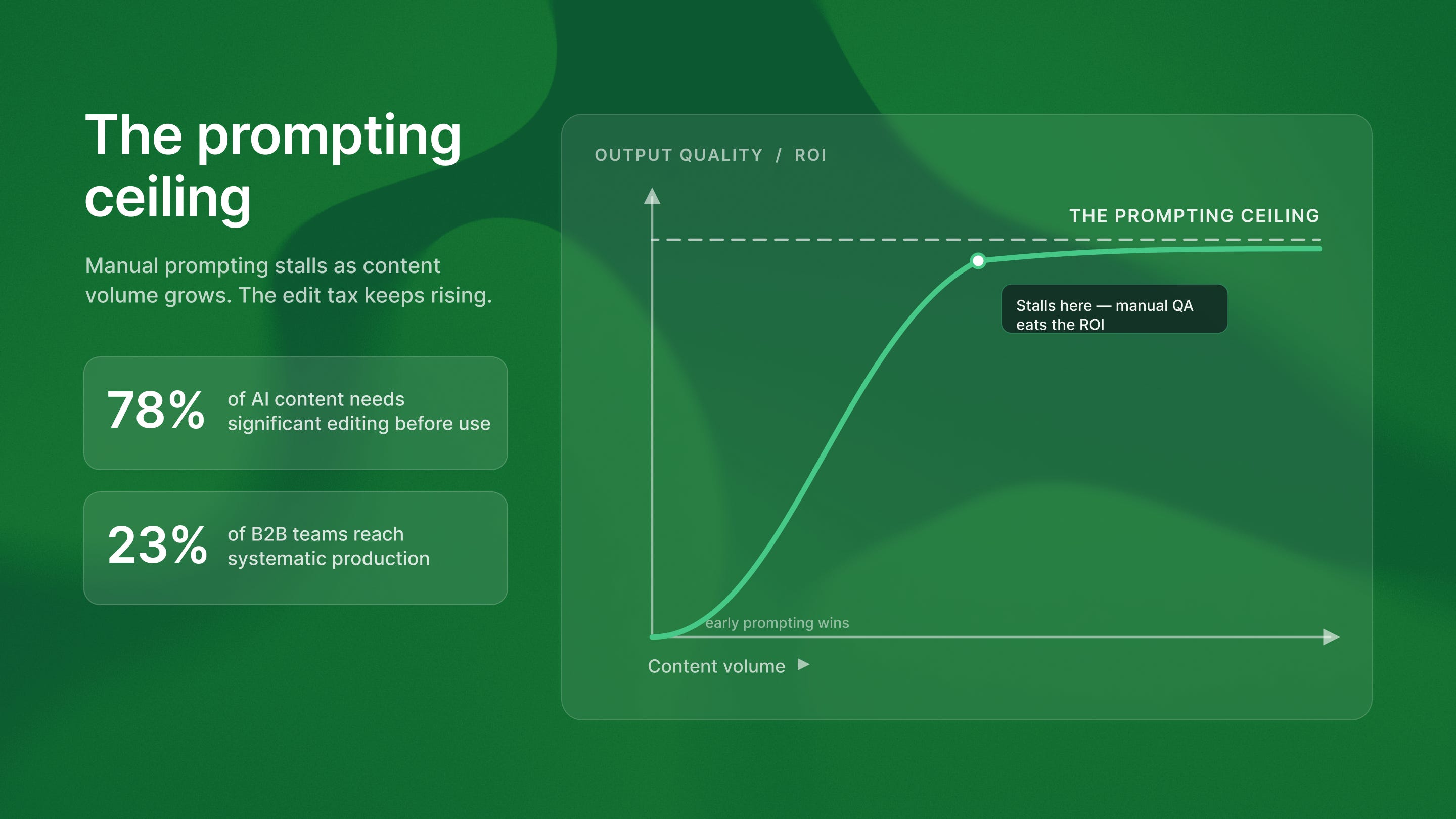
The hidden edit tax
Real SEO production needs sequential chains like SERP and gap analysis. Without them, the editor manually verifies every claim, fixes logic, and injects technical depth the LLM missed. This edit tax is why AI content initiatives fail to achieve positive ROI at the Series B level. Founders should instead focus on semantic depth and structured formatting to optimize content for AI citation.
Brittle wrappers vs. agentic systems
Many startups build brittle wrappers around a single LLM API, expecting the model to handle research, structure, and tone simultaneously. That’s a bug in the architecture. Agentic AI systems break these tasks into specialized nodes. Agencies that want to scale often look for White-label AI content solutions that use this modularity. One agent scrapes the SERP; another identifies content gaps; a third drafts the outline. This modularity ensures a failure in one area doesn’t corrupt the entire output. It enables sustainable AI content scaling without linear headcount growth.
Architecting the production-grade SEO pipeline
Content engineering is building systems that create content — not producing it piece by piece. A production-grade pipeline isn’t a single prompt; it’s a software product. It needs a stable linear trunk that handles the heavy lifting of data synthesis before a single word of the draft is written. Moving to citation-focused AI SEO keeps these systems relevant as search algorithms shift.
Linear research trunks
An effective pipeline starts with a research trunk that automates the grunt work. Tools like LangChain let you programmatically inject brand voice and semantic relevance, grounding output in your specific technical domain. Using a LangChain SEO pipeline yields more predictable results than standard API calls. This trunk typically follows a four-step sequence:
Signal Collection: Ingesting expert conversations from internal team channels to ground the AI in real expertise.
SERP Analysis: Using AI-native search engines to identify the table stakes for the keyword.
Semantic Mapping: Identifying related entities and technical terms to ensure topical authority.
Brief Generation: Producing a structured technical brief that constrains the drafting agent.
Automated SERP and gap analysis
The system must understand what competitors are doing before a draft is generated. Automated pipelines can reduce technical research and internal linking work. By using intelligent data extraction, the pipeline identifies exactly what competitors miss. That lets the AI draft content that provides unique value rather than echoing existing search results. For technical accuracy, these systems often rely on production-grade RAG pipelines that clean HTML and index web data incrementally.
Implementing quality gates and human-in-the-loop forks
Reliable systems don’t ship unchecked text. Architecture should follow a linear trunk with a specific quality fork that routes content based on confidence thresholds. That ensures high-authority technical pieces receive the scrutiny they deserve. Companies often choose a SaaS SEO content service to manage these sophisticated workflows at scale.
Automated Self-Scoring: The drafting agent scores its own output against the initial brief, checking keyword inclusion, tone adherence, and citation accuracy.
Threshold Routing: Content scoring above 90% goes to a Light Review lane for final formatting and internal link approval.
Human-in-the-loop Fork: Content below the threshold goes to a human editor with specific failures flagged inline. This hybrid AI content architecture maintains authority while significantly reducing manual work.
Action plan: moving to agentic AI systems
Audit your edit tax. If editors spend more than 90 minutes per post fixing AI drafts, your prompting architecture is broken. Decouple research from drafting with a separate script for SERP analysis and internal linking suggestions, and ensure clear input schemas to improve agent reliability. Implement LangChain SEO pipelines by moving prompts into a programmatic framework — similar to multi-stage agentic newsletter pipelines that maintain depth without overhead. Define quality gates with a clear rubric for publish-ready content, and automate initial scoring to identify pieces needing senior editorial intervention.
Growth-stage startups that rely on manual prompting will eventually be buried by the operational cost of their own content. The economic transformation of AI happens only when you treat content as a system. Building engineering-heavy pipelines avoids search penalties, maintains technical authority, and breaks the link between content volume and headcount.
Single-shot prompting is for prototypes, but agentic AI systems are for production. If you want to scale organic growth without sacrificing authority, stop writing prompts and start engineering systems.
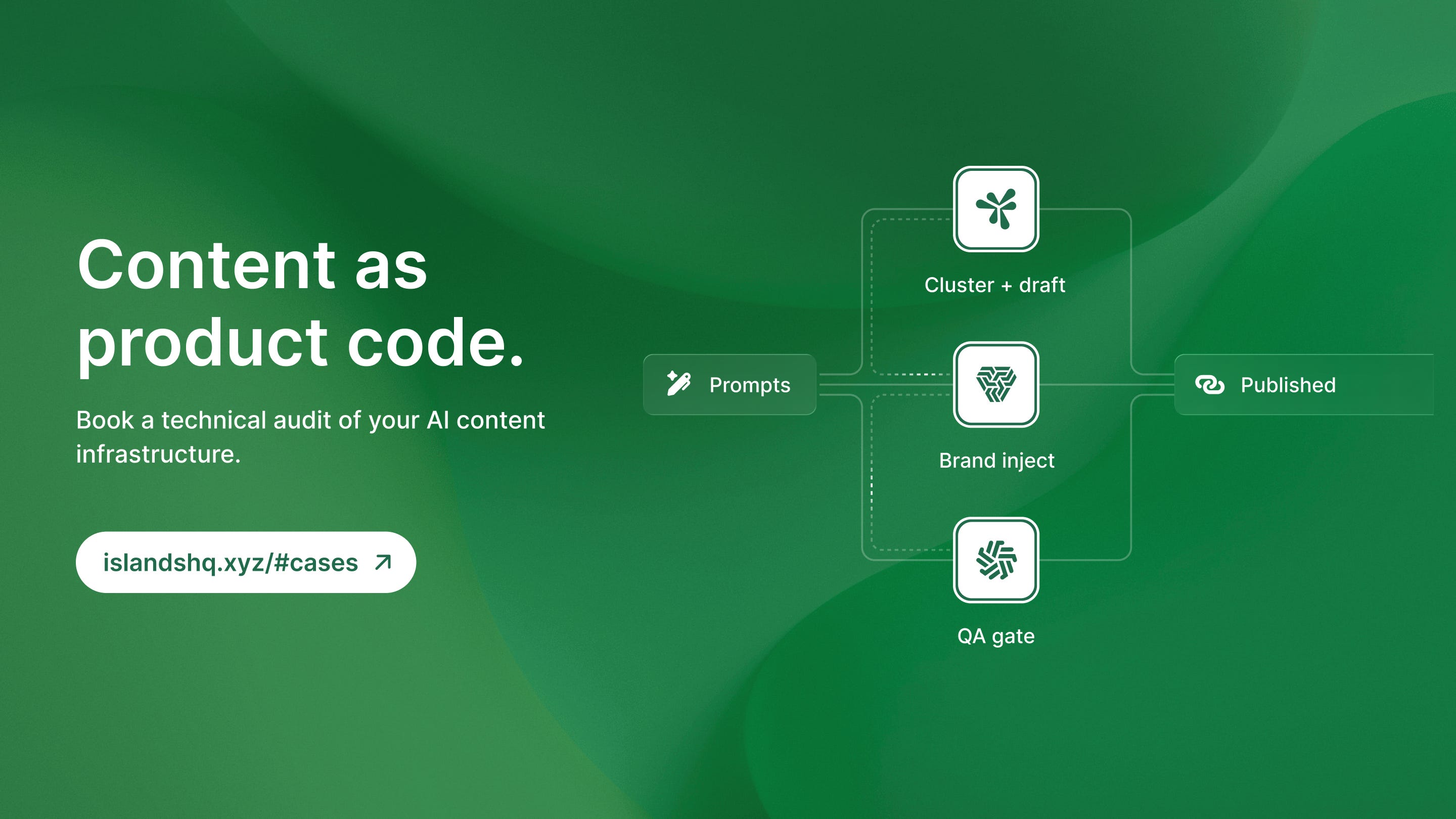
Ready to scale your organic growth with engineering-heavy pipelines? Book a call with Islands today.