


A VP of Engineering at a Series B fintech recently showed me their weekly newsletter. It sounded like a generic bot. They were using a single-prompt LLM wrapper, and the brand equity was leaking out with every send. The problem was the architecture they had built around the model. They treated AI as a typewriter when they should have treated it as a production pipeline.
AI newsletter automation is the most visible test of a brand’s technical maturity. If your content sounds like a machine wrote it, your customers will assume your product is just as hollow.
E. B. White made the same claim about prose in the chapter he added to The Elements of Style:
“Every writer, by the way he uses the language, reveals something of his spirit.”
E. B. White — “An Approach to Style,” The Elements of Style
White’s argument was that style is not a garnish applied to finished prose. It is nondetachable, in his word — the writer showing through whether they intend it or not. That is why generic copy reads as a signal rather than a stylistic preference. A reader who cannot detect a person behind the sentences will reasonably wonder whether there is much of one behind the product.
Single-prompting is an architectural trap. It lacks the iterative logic required to keep a consistent brand voice across complex tasks. To fix this, you must move from simple prompting to autonomous agentic systems.
Scaling with AI newsletter automation
Moving to this pipeline model changes content from a high-overhead task into a compounding technical asset. By using integrated content workflows, teams eliminate operational friction while preserving strategic judgment. Success here requires implementing reliable autonomous workflow systems that handle data ingestion and processing without manual intervention.
Coursera indicates that agentic design patterns enable autonomous behavior that maintains consistent logic across complex communication tasks. Organizations that switch to these special pipelines see better editing efficiency. They also keep a consistent brand voice across different content authors. Specialized QA agents can also reduce hallucinations in technical explanations by verifying output against source documentation.
Why single-prompt automation fails the brand test
When you send a single, massive prompt to an LLM, you are asking it to do too much. You are asking it to be a researcher, a writer, an editor, and a brand strategist all at once. This leads to the hallucination of voice. The AI defaults to a generic corporate tone because it lacks specific constraints. Many organizations fall into this brittle automation trap by prioritizing surface-level prompts over production-grade infrastructure.
The latency of context
A single prompt cannot hold the entire context of your brand’s history, market position, and technical depth. For Series B companies, poor workflow automation can cause a scaling trap. Headcount must then grow just to manage the AI’s output. The model produces something that looks like an email but feels like a template. It misses the nuance of your customer’s pain points because it tries to solve for everything in one pass.
The hallucination of voice
Without an iterative loop, the AI has no way to check its own work against your brand guidelines. It might use banned words or adopt a tone that is too promotional. To maintain consistency, companies need a brand voice AI configuration that strictly adheres to their unique identity. High-volume content requires a rigorous maintenance plan to prevent brand-damaging hallucinations. Systems that lack this layer often fail to meet the Islands benchmark for production content.
The architecture of an agentic newsletter pipeline
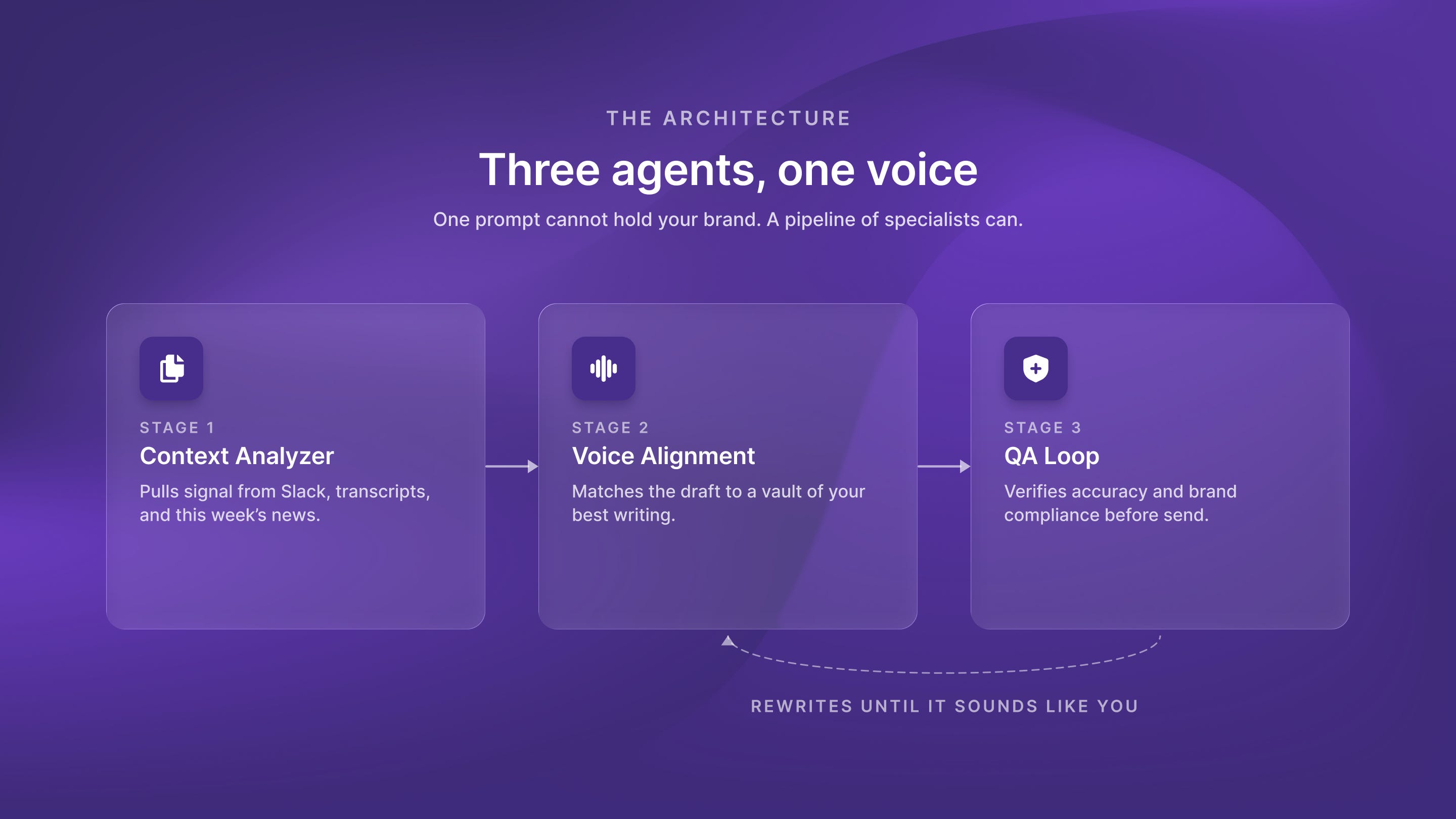
To build a system that sounds human, you need to break the task into specialized sub-agents. This mirrors a high-end editorial workflow. By using clear agentic design patterns, you can send tasks to the best model for research or creative writing. Instead of one prompt, you build a multi-stage pipeline where each agent has a specific job. This is how you transition to autonomous systems that maintain brand logic.
The Context Analyzer: This agent takes in raw data, like Slack chats or meeting transcripts, to find key insights.
The Voice Alignment Agent: This agent takes the raw insights and applies your specific brand filters. This ensures the tone matches your established voice.
The QA flow Loop: This agent acts as the final editor. It checks technical accuracy and searches for banned words. It uses the same logic as Islands autonomous testing systems.
What to do next: a 30-day implementation roadmap
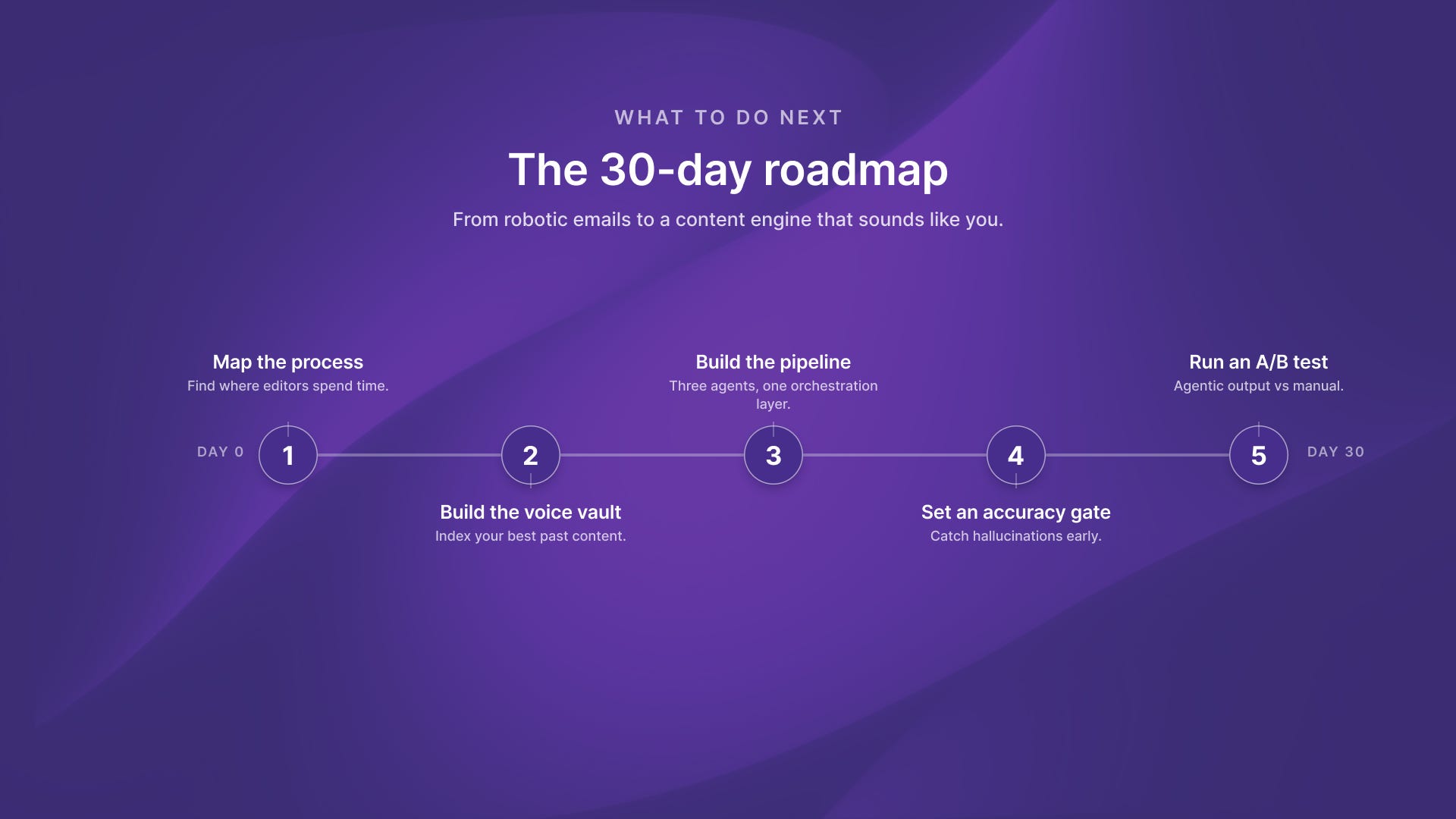
If you want to stop sending robotic emails and start building a content engine, follow this path:
Map your manual editorial process and identify every decision point a human makes.
Set up an ingestion pipeline for internal knowledge. Move from manual briefings to turning internal conversations into assets.
Build your first specialized agent focused purely on research and fact-checking.
Connect your research agent to a drafting agent that uses your brand style guide as its primary constraint.
Implement a final human-in-the-loop checkpoint to validate the output before it hits the send button.
The bottom line

Brand authenticity is an architectural problem. If your AI strategy depends on the quality of a human’s prompt, you haven’t built an autonomous system. You have built a digital intern. Move beyond demos and build production-grade AI agents that represent your brand as well as you do.
Reach out to Islands if you are ready to audit your content architecture.