
I’ve been talking to CTOs who are tired of hiring cycles that burn six months on the wrong candidate. The pressure to build internal AI capability is real - you have the budget, the urgency, and the strategy. But one wrong hire can set you back half a year. Hiring your first AI engineer is fundamentally different from hiring a generalist software engineer. The right hire focuses on production ML engineering over research capability. A structured assessment process can predict success better than standard interviews. It can include a take-home task on data pipelines. It can also include a take-home task on model deployment.
I’ve hired for over 100 ventures at Islands and seen the same mistakes repeated. Unstructured technical processes let AI-generated resumes and unqualified candidates slip through (Shoreline). Here is a playbook for finding, evaluating, and onboarding your first AI engineer.
Key results: what this playbook delivers
Faster time-to-hire by focusing on production skills, not research credentials
Higher probability of success - candidates who pass the take-home task tend to ship faster
Lower risk of mismatch - you know what you’re getting before you make an offer
Why hiring an AI engineer is different
The average time-to-hire for a senior AI engineer exceeds 6 months. Every hire is high-stakes. You can’t afford to spend months on a candidate who doesn’t work out. In fact, many smart companies rent AI talent through fractional engagements. This helps compress deployment timelines while they search for the right full-time hire (Islands).
Researcher vs. production engineer
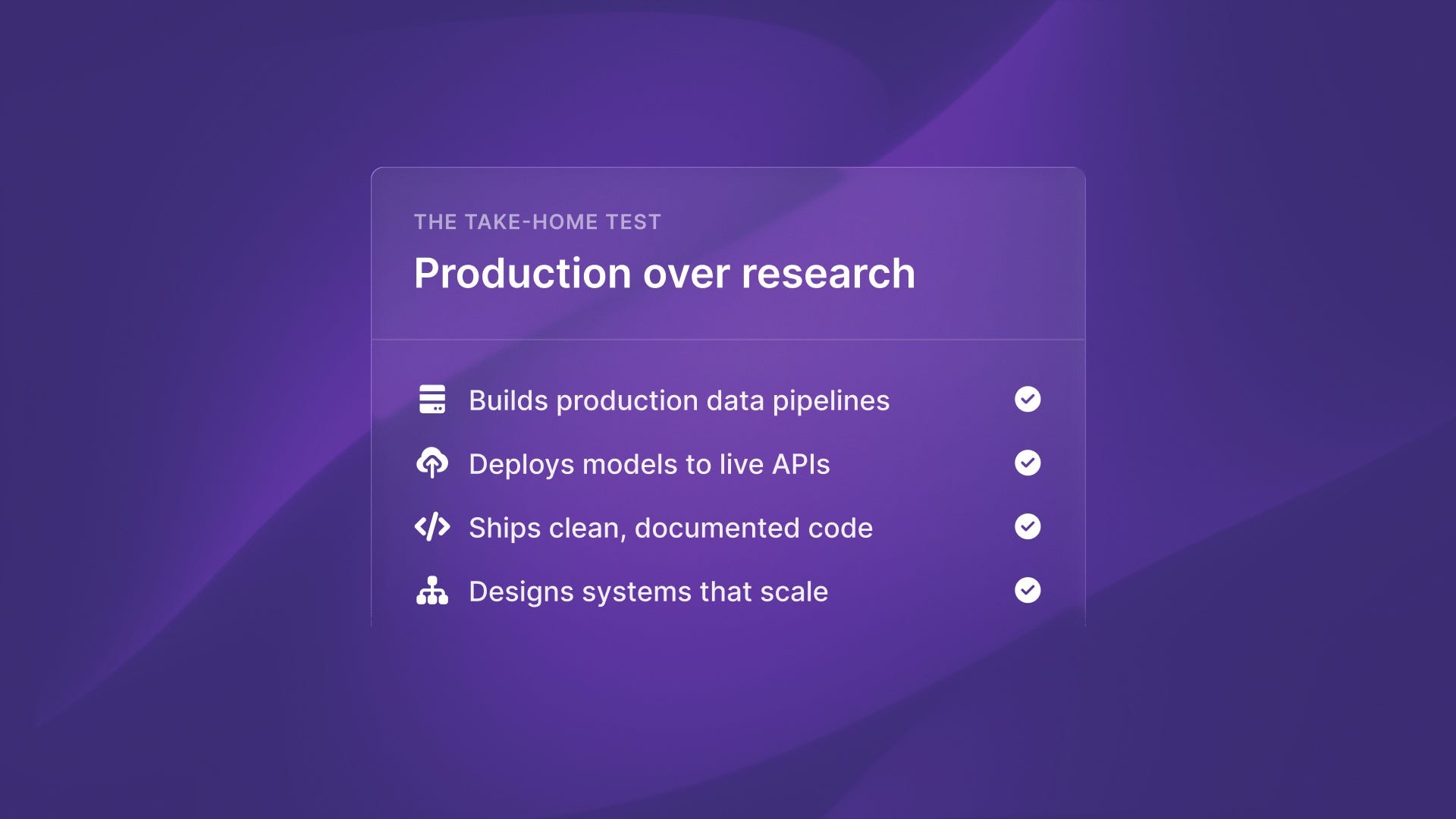
Most hiring processes overvalue research credentials - PhDs, publications, Kaggle competitions. But what you need is someone who can deploy models to production, build data pipelines, and optimize for latency and cost. The AI engineering talent shortage is real, and it makes every hire high-stakes. The distinction between researcher and production engineer is critical, and most teams get it wrong.
What to look for in your first AI engineer
Production mindset over research chops. Can they ship code that runs reliably under load? Ask about their experience with monitoring, logging, and incident response. 95% of enterprise AI pilots fail because teams build prototypes instead of production-ready systems (Islands). Your first AI hire needs to know the difference.
Data engineering as a core skill. Your first AI engineer will spend more time on data pipelines than on model architecture. Look for experience with ETL, data validation, and feature stores. These are the production AI engineer skills that actually matter.
Model deployment experience. Have they deployed models to production? Do they know Docker, Kubernetes, and model serving frameworks like TorchServe or TensorFlow Serving? If they can’t ship, they’re not an engineer.
The assessment that predicts success
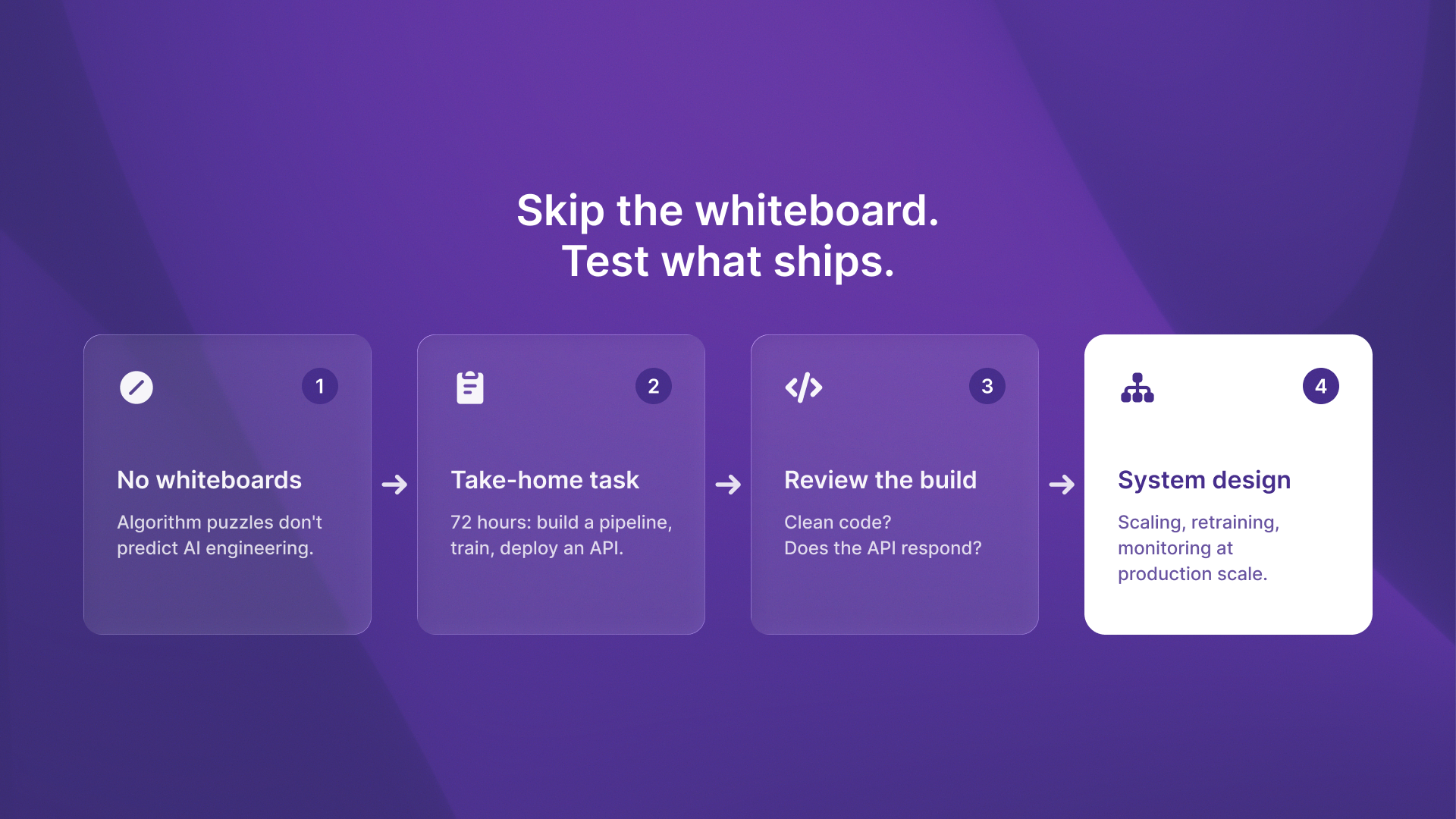
Step 1: Reject the whiteboard. Standard algorithm questions don’t predict AI engineering ability. Instead, design a take-home task that mirrors real production work. This is the core of your AI engineer interview process.
Step 2: Design a take-home task. Give the candidate a dataset and ask them to build a small data pipeline, train a model, and deploy it as an API. Provide 72 hours. This tests everything that matters: data handling, model selection, and deployment.
Step 3: Review the code and the deployment. Look for clean code, error handling, and documentation. Does the API work? Can you call it and get a response?
Step 4: Conduct a system design interview. Ask them to design a production AI system - how would they handle scaling, retraining, and monitoring? This separates engineers from researchers.
Onboarding your first AI engineer for impact
Day one: data access and context
Give them access to the data pipelines and production systems immediately. Don’t waste the first week on orientation. Let them explore the data and understand the current state. Your first AI engineer hire needs to ship fast, or you risk losing them to frustration.
Week one: first production deployment
Set a goal: deploy a simple model or improve an existing pipeline by the end of the first week. This builds confidence and shows they can ship. If they can’t, you caught the mismatch early.
Month one: autonomy with guardrails
By month one, they should be owning a feature or a model. Provide guardrails — code reviews, monitoring alerts - but let them drive. The best AI engineers thrive with autonomy. Early-stage teams that fail with critical hires often do so because they hire roles they cannot yet manage (Shoreline). Make sure you have the infrastructure to support them.
The bottom line
The right AI engineer can transform your entire workflow. But only if you hire for production skills, not research credentials. Use the take-home task as your primary filter, and onboard for impact from day one.
Ready to build your AI team? Check out how Islands helps you hire and deploy AI talent.