


I’ve been watching something fascinating unfold across our portfolio. Companies with $10M-50M in revenue are all getting the same pressure from boards: ship AI capabilities, fast. The playbook everyone reaches for? Hire an AI executive. Post the role, start the search, wait 3-6 months, write the $300K-500K offer.
Meanwhile, their competitors are deploying production agents in 8 weeks.
Here’s what’s actually happening. Leadership roles related to artificial intelligence grew between 40% and 60% in fiscal year 2025 (Market reporting 2025). That surge created a talent war. Executive searches that used to take 8-12 weeks now stretch to 4-6 months. Compensation packages climbed into the $300K-500K range. And while you’re interviewing candidates, your window for AI differentiation is closing.
The companies moving fastest aren’t playing this game. They’re renting expertise instead of hiring it.
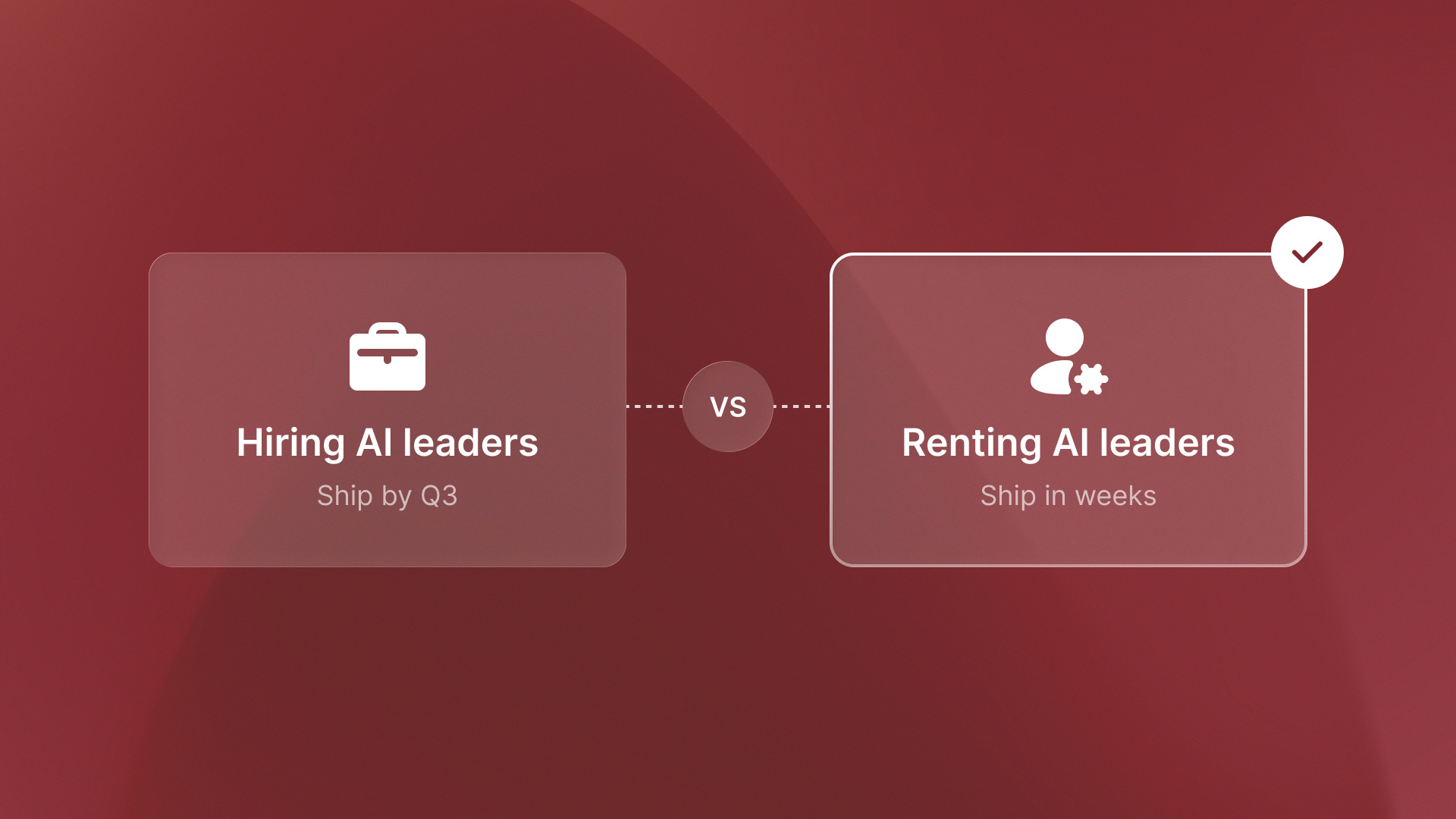
The hiring timeline problem
Let me walk through the math on traditional AI executive hiring.
Month 1–2: Write the job description. Post the role. Source candidates.
Month 2–4: Run first-round interviews. Give technical assessments. Check culture fit.
Month 4–5: Hold final-round interviews. Complete reference checks. Negotiate the offer.
Month 5–6: Candidate serves notice at their current employer. Begin onboarding
You’re 6 months in before your new AI leader writes their first line of architecture code. Add another 2-3 months for them to assess your stack, understand your business context, and propose an approach. Now you’re 8-9 months from starting the search to beginning actual AI system development.
I watched a Series B fintech go through exactly this process last year. Posted the VP of AI role in February. Made an offer in July. New executive started in September. First production agent shipped in March. Fourteen months, start to finish.
Their competitor used a fractional CTO model. Started in February. Shipped their first production agent in May. Three months.
The difference wasn’t talent quality. It was model choice.
What fractional actually means for AI transformation
Fractional CTO services cost $10,000-25,000 per month, representing 60-80% savings compared to full-time executives (Pangea.ai 2025 Market Benchmarks). But the cost arbitrage isn’t the compelling part. The velocity is.
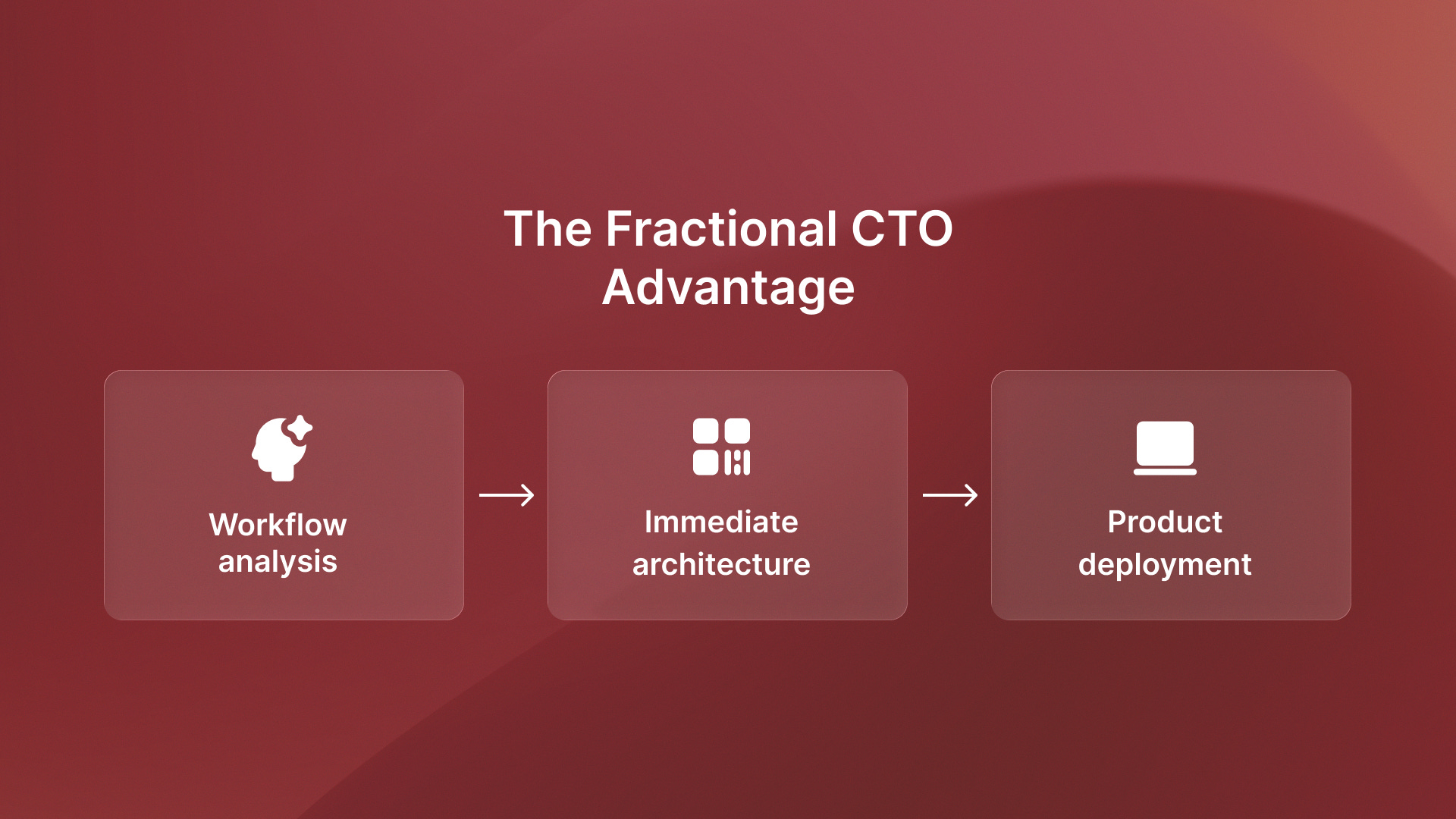
Here’s what fractional engagement looks like in practice. You bring in a CTO-level practitioner who has already built production AI agents at 3-5 other companies. They know the architectural patterns. They’ve made the agent-versus-assistant decision before. They understand the infrastructure requirements for autonomous systems. They bring proven playbooks, not theories.
Week 1-2: Technical assessment and architecture proposal.
Week 3-4: Team alignment and the first development sprint.
Week 5-8: First production agent deployment.
Week 9-12: Iteration, monitoring, and planning for expansion
You’re shipping real autonomous systems in the time it takes to schedule second-round interviews for a full-time hire.
I spoke with a company last month. They use Timecapsule for time tracking. They shared something that shows this well. They needed to build an AI agent that would automatically flag projects trending toward losses and suggest resource reallocation. Their fractional CTO joined the team and spent two weeks learning their margin calculation logic. A working agent was live in production by week six. The agent now monitors 40+ projects at once. It catches margin erosion 3–4 weeks earlier than the old manual review process. Total time from decision to deployment: 42 days.
That’s the pattern we see repeatedly. Fractional expertise compresses the strategy-to-production timeline because you’re not starting from zero on architectural knowledge.
Why consultants can’t solve this
Most consulting engagements follow a predictable arc. Discovery phase, strategy development, roadmap creation, handoff to internal teams for execution. You end up with a great deck and a 12-month plan. It still requires hiring the team you couldn’t hire before.
Consultants deliver recommendations. Fractional CTOs ship code.
The architectural decision between AI assistants and autonomous agents is where this distinction becomes critical. Most companies waste 6-12 months building assistant-style copilots when their business actually needs workflow replacement. This isn’t an execution problem. It’s an expertise gap at the leadership level.
I wrote about this distinction in detail here: Why Only Autonomous Systems Deliver 420% ROI. The short version: assistants augment human workflows, agents replace them entirely. The ROI difference is massive. But making that architectural choice correctly requires production experience, not consulting frameworks.
A fractional CTO who has built both models can tell you in week one which architecture fits your use case. A consultant will give you a decision matrix and let you figure it out.
The business case that actually matters
SMEs with strong tech leadership see 18% higher revenue growth and 15% higher profits than competitors. (CTOx ROI Analysis 2025). The question isn’t whether to invest in AI leadership. It’s which model gets you there fastest.
Let me show you the scenarios:
Full-time hire path:
$300K-500K annual cost
6 months to start date
2-3 months to ramp and propose architecture
3-4 months to first production deployment
Total: 11-13 months, $275K-460K spent
Fractional CTO path:
$15K-25K monthly cost
Immediate start
2 weeks to architecture proposal
6-8 weeks to first production deployment
Total: 2-3 months, $45K-75K spent
The cost delta is obvious. But the real competitive advantage is the 9-month head start on shipping AI capabilities.
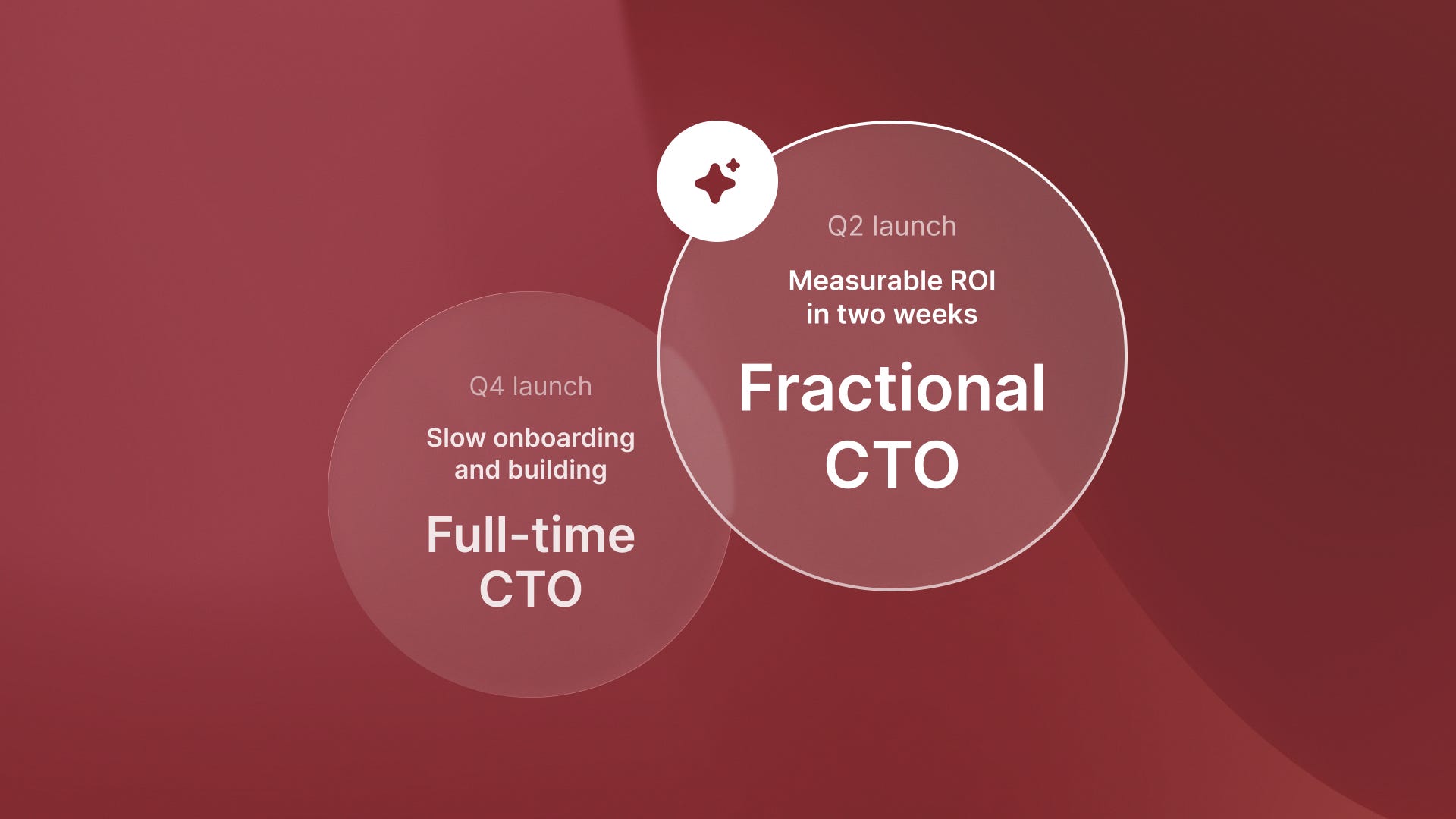
What can you build in 9 months? I’m working with a company that deployed its first agent in March. They improved it based on real user behavior over the summer. By December, they had three autonomous agents handling different workflow areas. Their competitor hired a full-time AI executive in March. That person started in August. First agent is scheduled for Q2 2026.
By the time the competitor ships their first agent, we’ll have a year of production data. We’ll also have user behavior insights and architecture improvements.
What this actually looks like in practice
Last quarter I had a conversation with a team building autonomous QA testing. They were stuck between two choices. One was an assistant that helps QA engineers write tests faster. The other was an agent that generates and runs tests on its own. Classic architectural fork.
We identified what they needed. The system takes Figma designs. It generates full test coverage. It runs regression tests when developers push code. That’s full workflow replacement, not workflow augmentation. They needed an autonomous agent, not an assistant.
Six weeks later they had a working system. You can see how it works at QA flow. The agent detects 847 bugs monthly across their customer base. The companies using it reduced QA cycle time by 60-70%.
That architectural decision, made correctly in week one, determined whether they’d build something transformative or incremental. A fractional CTO with production agent experience could make that call immediately. A consultant would have delivered a framework for evaluating the tradeoffs.
The 2026 landscape
Here’s what I’m watching for the next 12-18 months.
Companies that moved fast on AI with fractional expertise are building competitive moats. They’re shipping agents, gathering production data, and iterating on real user behavior. Their AI capabilities are becoming embedded in customer workflows.
Companies that chose traditional hiring models are still building teams. Some are still interviewing candidates. Others are waiting for new executives to ramp and propose architectures. A few are watching consultants present strategy decks.
The window for AI transformation advantage is narrowing fast. In 12-18 months, AI capabilities won’t be differentiators anymore. They’ll be table stakes. Every SaaS platform will have agents handling workflow automation. Every data product will have autonomous analysis.
The companies winning will be those who chose execution velocity over traditional hiring models. They started building in Q1 2025 while competitors were still posting job descriptions. By Q3 2026, they’ll have 18 months of production data and three generations of agent improvements.
Their competitors will be shipping version 1.0.
The leadership model you choose today determines which timeline you’re on. Six months from now, you’ll either be iterating on your third agent deployment or interviewing executive candidates. The choice is strategic timing, not just organizational structure.
Build Your First AI Agent in 30 Days The architecture patterns, infrastructure decisions, and deployment strategies are all there.
But the leadership model that gets you from strategy to production? That choice happens before you write the first line of code. And it determines whether you’re building competitive advantage or playing catch-up.