


I recently watched a Series B founder pitch a revolutionary AI interface. The lead partner told them they do not fund wrappers anymore. The founder was confused. They had the users and the revenue, but they did not have the architecture. The market has moved. If your technical moat is just a clever system prompt, your valuation is at risk.
AI venture capital is no longer interested in how well you can use an API. They are looking for how well you can replace a workflow. The difference between an assistant and an autonomous agent can decide success or a quiet shutdown. This shift explains why AI founders are skipping seed rounds to access more durable infrastructure earlier in their lifecycle.
The death of the thin wrapper: why AI venture capital is shifting
Thin-wrapper applications are those that primarily provide a UI for a third-party model. Investors realized that these products have zero defensive surface area. If OpenAI or Anthropic releases a feature that mimics your UI, your business evaporates overnight. Many founders now choose production-ready agent designs that offer fast technical defensibility, instead of building from scratch.
This funding paradox is real. While AI got 80% of global venture funding last quarter, according to TechTimes. Most of that money does not go to the surface layer. VCs are moving down the stack. They want to see proprietary state management and systems that do not break when the underlying model changes. Developing a Series B AI strategy now requires demonstrating that your product is a complete system. They are looking for companies that have moved from plumbing to prose. In these cases, the value is in the execution of the task, not the generation of the text. Often, AI business cases fail because they prioritize simple productivity over fundamental EBIT impact.
Herbert Simon described the basic economics of this in 1971. He won the Nobel Prize in economics seven years later.
“...a wealth of information creates a poverty of attention.”
Herbert A. Simon — “Designing Organizations for an Information-Rich World,” 1971
His argument was that information consumes attention, so abundance makes attention the scarce resource rather than the information itself. A wrapper produces information. It generates text that a person then has to read, verify and act on, which means every unit of output it creates also consumes a unit of the thing that is genuinely scarce. An agent that completes the task consumes no attention at all. That is the economic difference investors are now pricing, and it is why output volume has stopped functioning as a moat.
AI architecture and funding comparison

What AI venture capital actually wants: the three moats
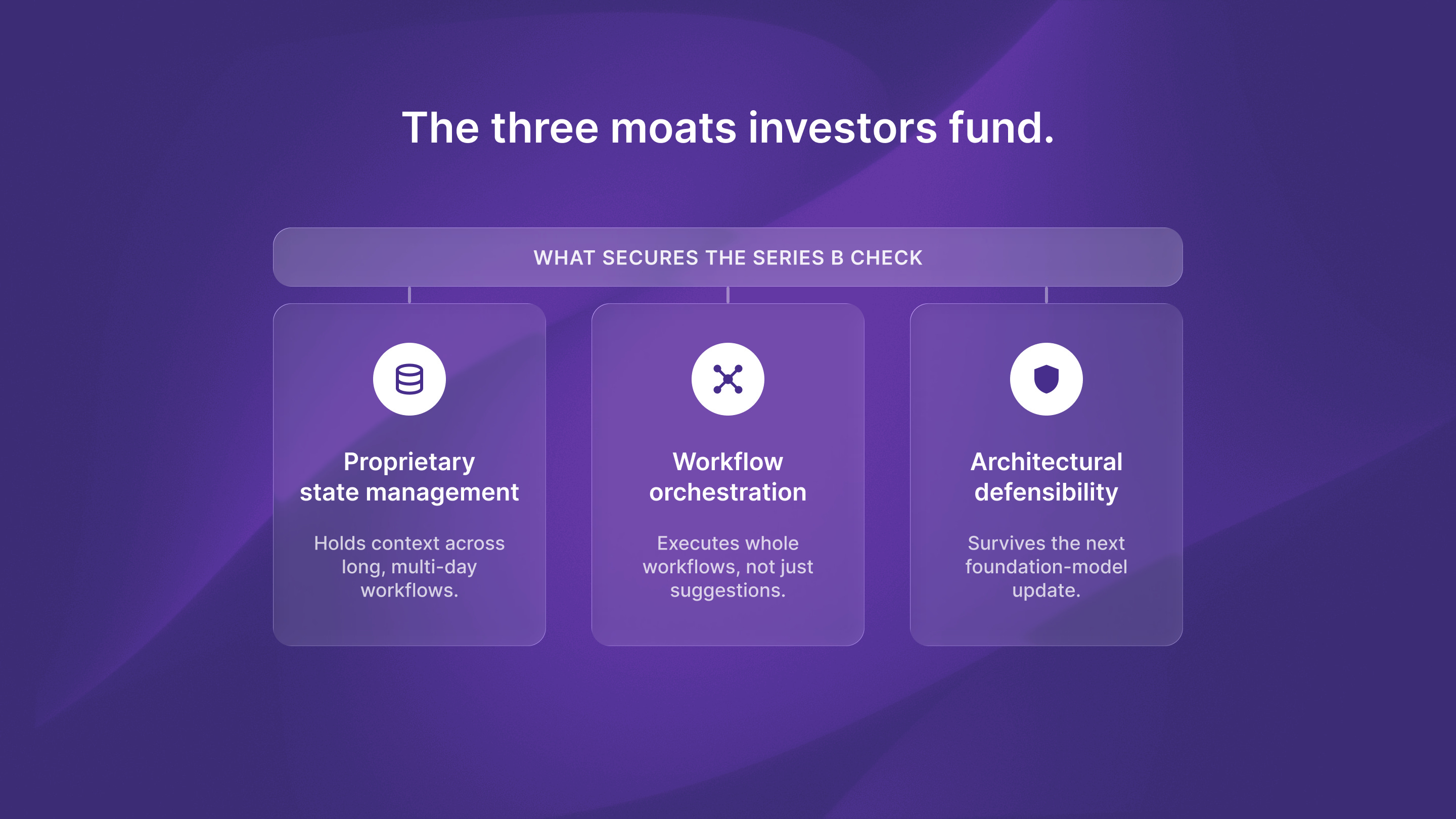
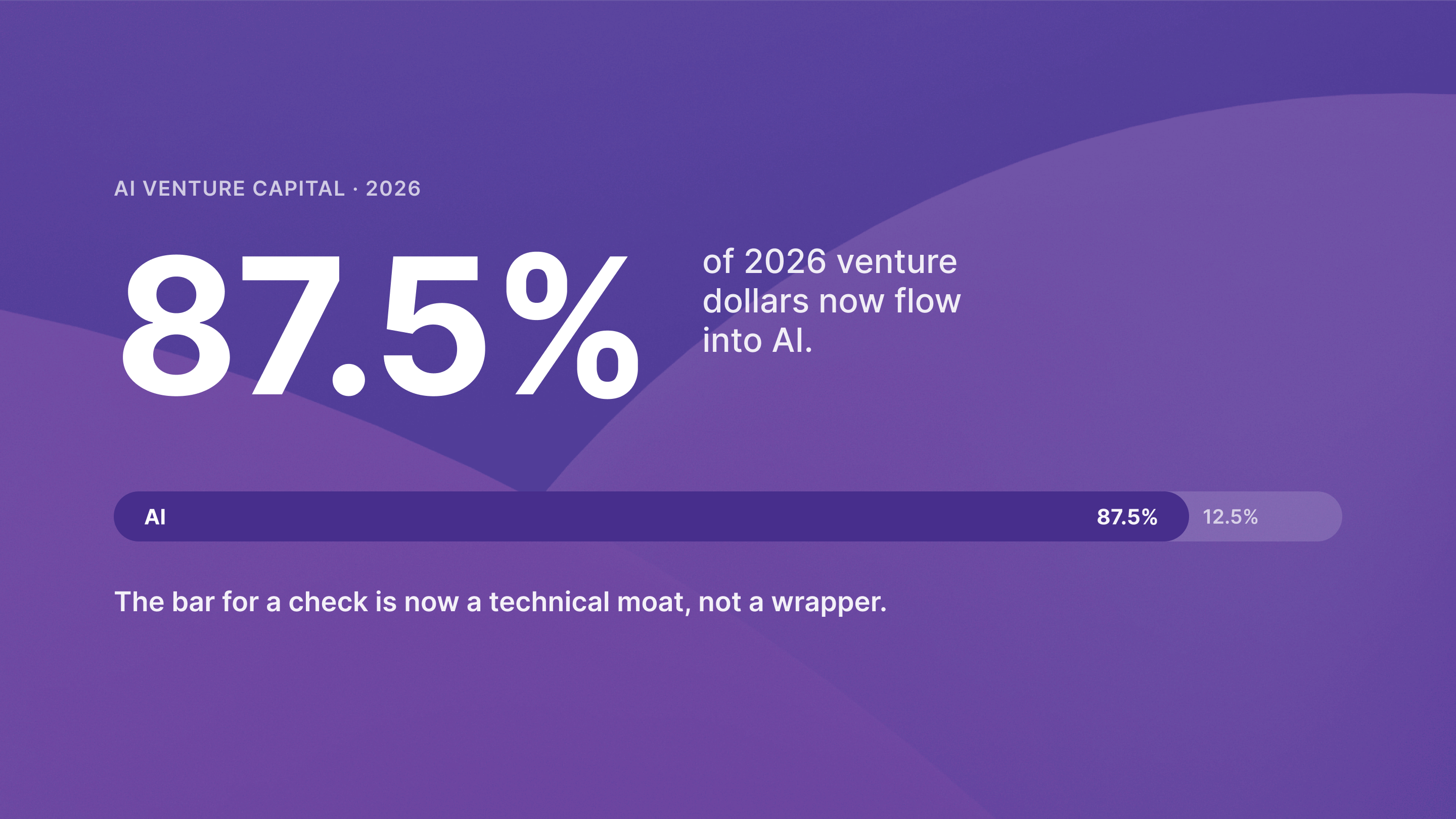
To secure a Series B or C, you must demonstrate AI technical moats that go beyond data moats. Recent data shows that 87.5% of venture dollars go to the AI sector (Fortune). This trend raises the bar for differentiation. Investors are looking for:
Proprietary state management: The system must handle complex, multi-day workflows without losing context.
Workflow-level orchestration: The product manages multiple autonomous agents and tools to complete a business objective.
Unit economics of autonomy: The system replaces linear headcount growth with exponential capacity. To avoid the headcount trap, many firms are adopting a shared orchestration layer to recycle logic across different functions.
Integration depth: The agentic logic is embedded in the customer’s existing operational stack.
If you cannot answer these questions, you likely lack the technical infrastructure required for modern enterprise scale. Winners focus on the system, while the rest focus on the prompt. Build. Run. Maintain.
From assistants to agents: the architectural shift
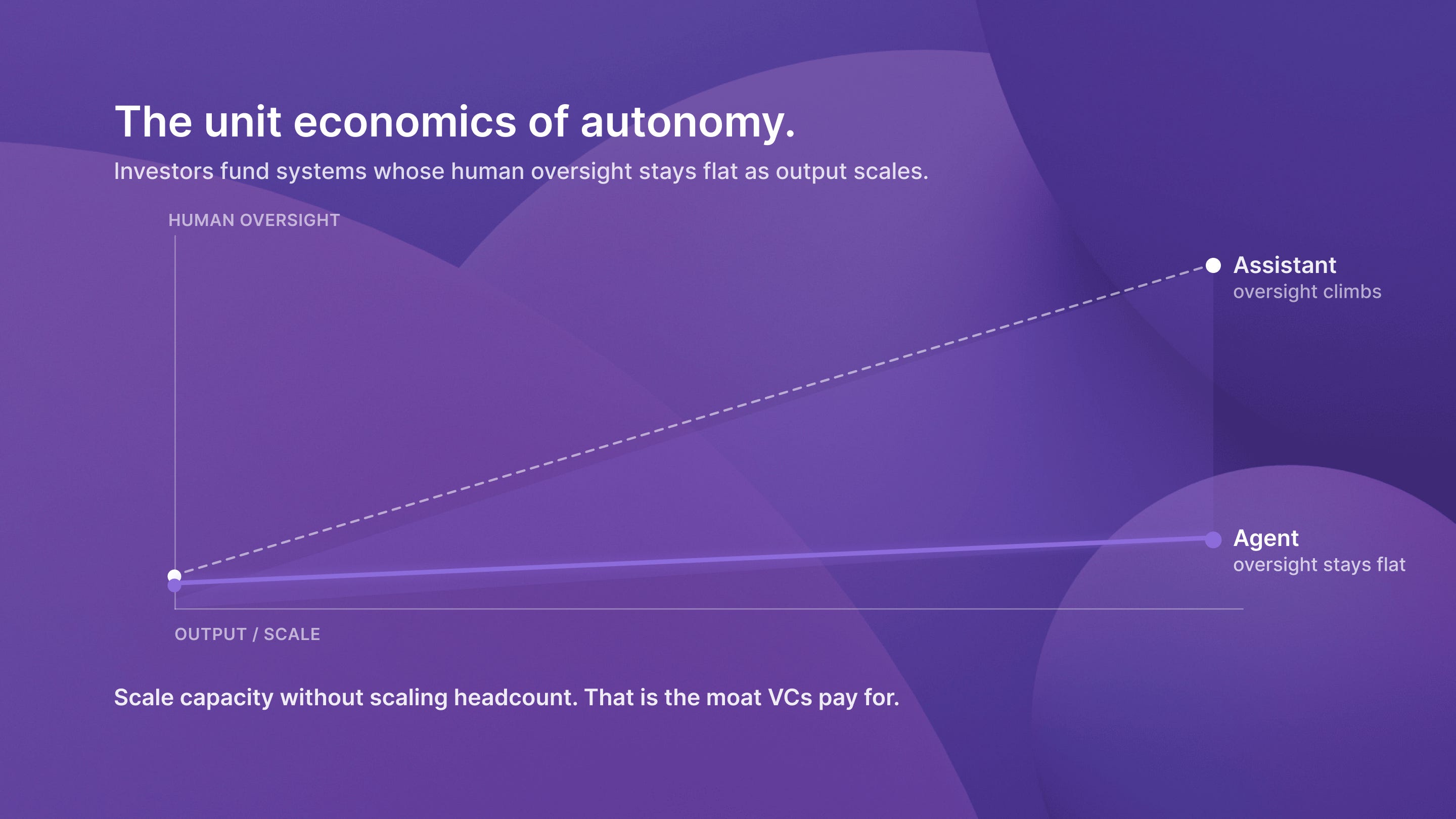
I see this change clearly in autonomous testing systems like QA flow. They understand a goal and run an audit on their own. This is what investors mean by workflow replacement. Beyond mere efficiency, companies must demonstrate a clear workflow automation ROI to justify high valuations. It is a system that moves from being a tool in a person’s hand to being a node in the company’s infrastructure. Before working with builders, smart founders use a venture studio checklist. It helps ensure they get real support, not just capital.
Building for production reliability is the new standard. Many companies are now recycling AI workflows across their portfolio. This shift increases architectural rigor and builds a more stable defense against model commoditization.
Action steps: auditing your AI architecture
Before your next board meeting or fundraising pitch, you must audit your technical depth. Follow these steps to ensure you are not building on sand:
Map your dependencies: Identify which parts of your product would be rendered obsolete by a model update.
Evaluate your state layer: Determine if your autonomous agents can recover from errors independently.
Measure your autonomy ratio: Calculate what percentage of your core workflows are completed without human oversight.
Document your orchestration: Clearly define how your system manages tool access.
The bottom line
Venture capital rewards technical depth and autonomous workflow replacement. If you are building a wrapper, you are building a feature, not a company. Real value lies in the systems that can run themselves.
Build. Run. Maintain.

Ready to build a defensible architecture? Book a call with Islands today.