


A founder at a Series B fintech startup shared that their team spent six months building an AI assistant. Nobody uses it. The problem originated in discovery. They fell into an architectural trap, building a solution for a problem that did not exist. They spent significant engineering hours to build a faster way to do something that users preferred doing manually. Charlie Songhurst, the former Microsoft strategy lead, notes that the best businesses are compounding machines. In AI product development, a discovery workshop that fails to prove ROI represents a significant waste of resources.
Transitioning to agentic discovery
Product discovery workshop frameworks for AI differ from traditional SaaS discovery. You are validating the technical feasibility of an agentic loop and the unit economics of autonomous action. Series B founders must prioritize features providing measurable ROI rather than generic AI productivity boosters. If you cannot prove the EBIT impact in a 60-minute session, the feature likely lacks viability. This requires shifting from generative AI wrappers to autonomous agentic systems that solve functional workflows.
Key results of this shift include:
Moving from UI validation to technical feasibility of the agentic loop
Prioritizing EBIT impact over general productivity features
Identifying hidden infrastructure costs like RAG and tokens early
Aligning engineering and product teams on latency thresholds
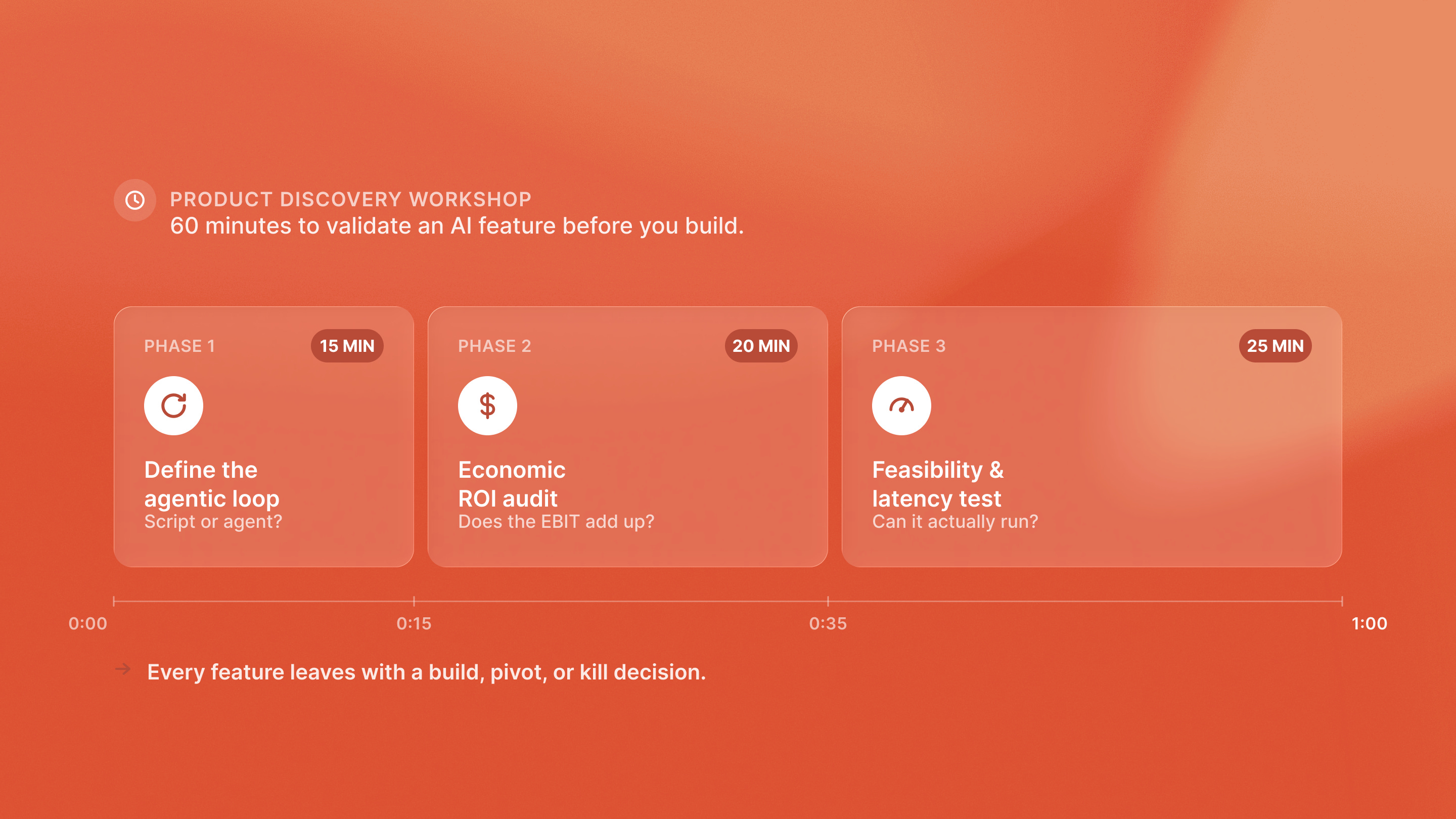
The 60-minute product discovery workshop framework
This workshop forces technical and business leaders into alignment, moving away from hype toward architectural rigor. Validating an AI idea before writing code prevents massive resource waste. To make sure your AI idea will work and make financial sense, pass five tests to validate your AI idea. Do this before you invest in engineering. Performing a comprehensive validation ensures the logic behind your agent is sound before deployment.
Phase 1: Defining the agentic loop (15 min)
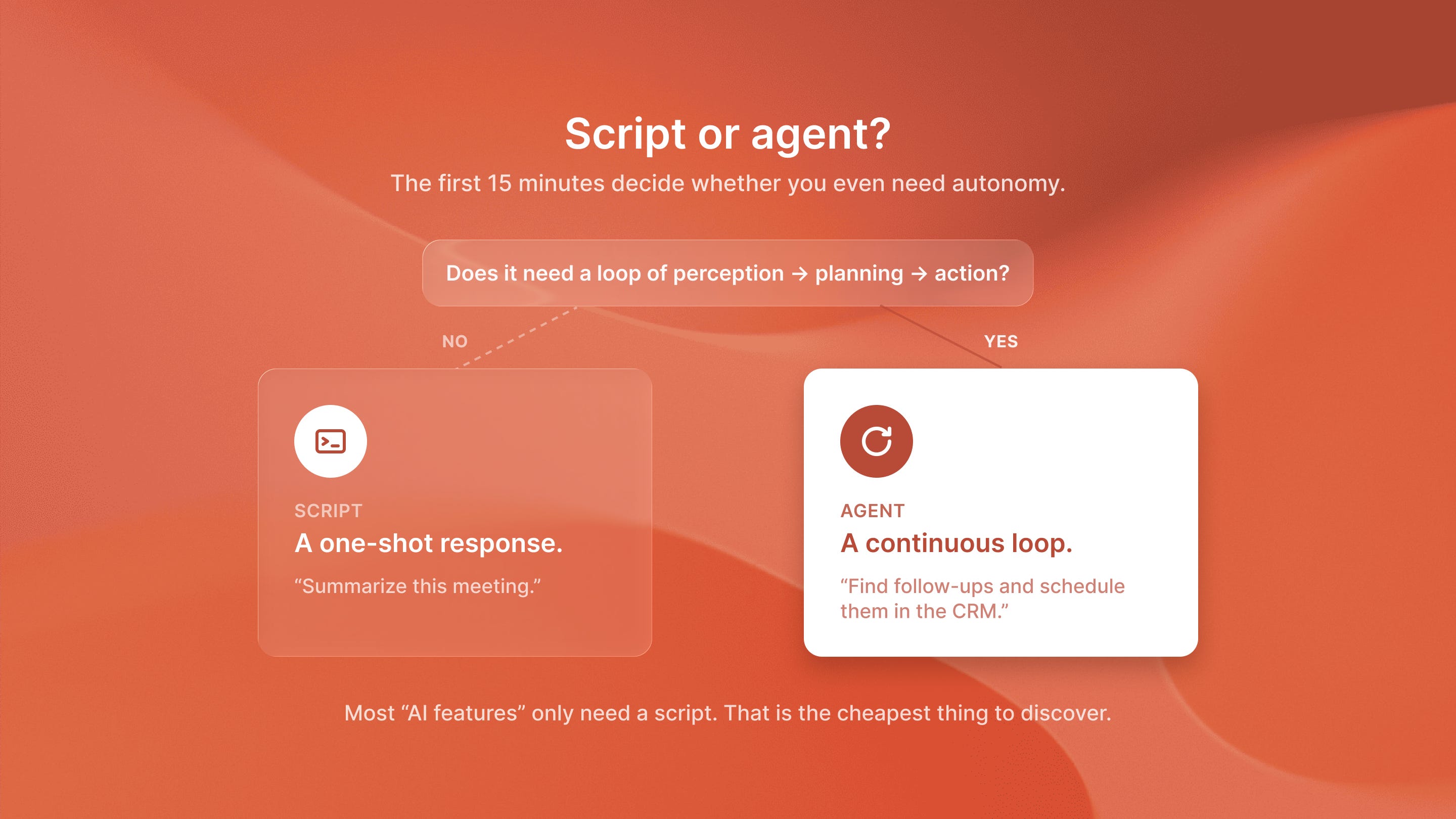
Start by mapping the workflow to determine if the system is a simple chatbot or an autonomous agent. Identify the triggers, actions, and feedback loops. If the system requires a human to check every step, it is a high-latency assistant, not an agent. Define how the system will handle multi-step reasoning without constant oversight. Adopting intent-based testing prevents scaling bottlenecks as you move from automated scripts to autonomous systems like QA flow.
Phase 2: The economic ROI audit (20 min)
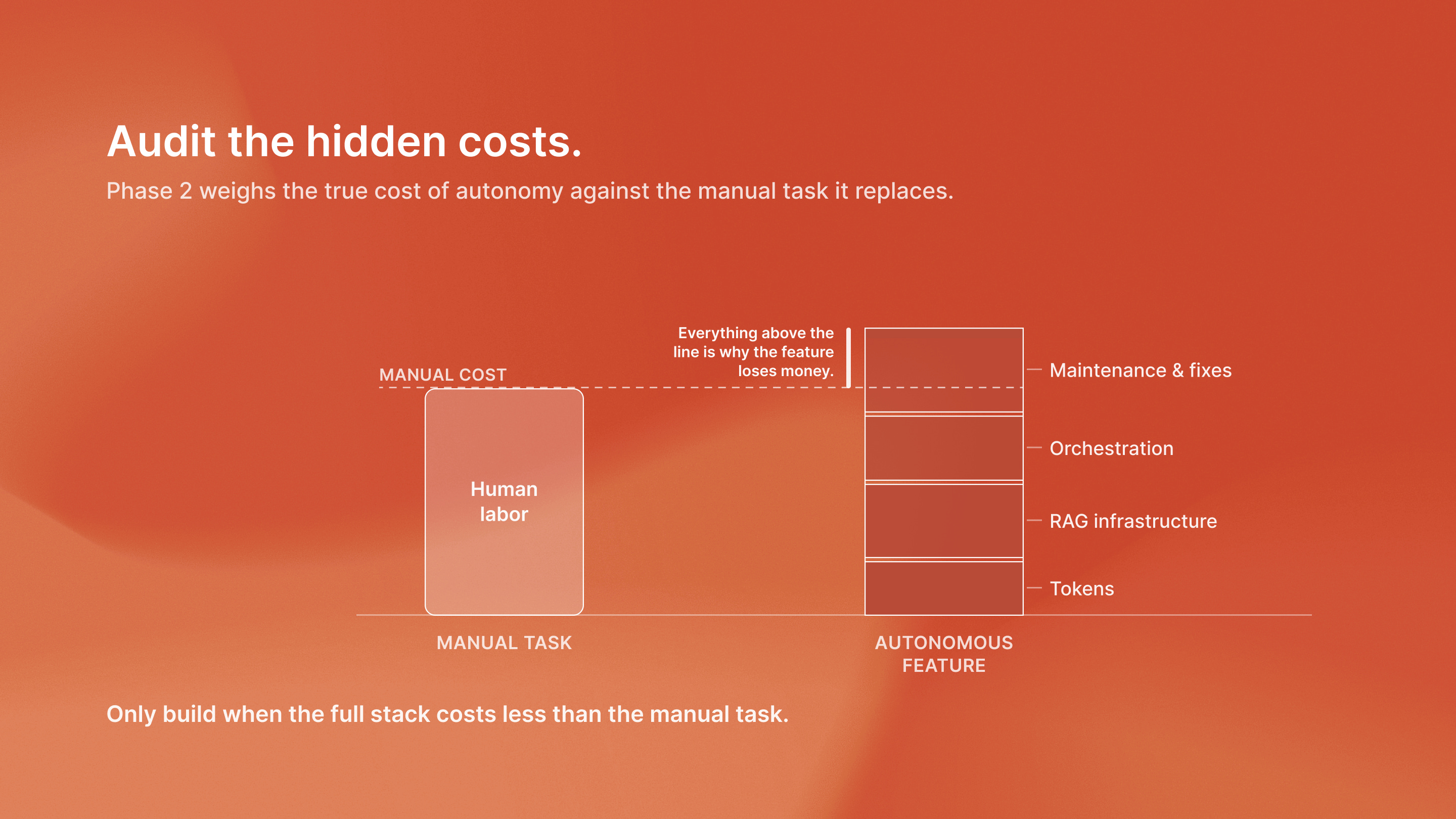
Compare the cost of manual execution against autonomous execution. Many AI business cases fail because they ignore production costs. These costs include API tokens, RAG infrastructure, and the work of fixing hallucinations. Build a case that survives board scrutiny by mapping workflow replacement economics and accounting for hidden infrastructure costs. Neglecting EBIT impact and hidden costs usually results in project abandonment.
Phase 3: Feasibility and latency stress test (25 min)
Determine if the model can handle the required context and if the latency is acceptable for the user intent. If an agent takes two minutes to respond to a simple query, the user experience fails.
Jakob Nielsen fixed the relevant threshold in 1993, drawing on response-time research going back to 1968. Ten seconds, he wrote, is:
“...about the limit for keeping the user’s attention focused on the dialogue.”
Jakob Nielsen - Usability Engineering, 1993
Past that point users go and do something else, and the interaction becomes asynchronous whether you designed it that way or not. Two minutes is twelve times the limit. That does not automatically kill a feature, but it does set the interface. Anything beyond ten seconds must run as a job. The user can check back later. Show visible progress and an estimate. Do not make it a request they must wait on. Phase 3 is where that gets decided, and deciding it here costs a conversation instead of a sprint. Evaluate the orchestration layer requirements and the reliability of data sources. A startup’s orchestration layer and technical stack are more critical than capital when building autonomous systems. Establishing a sound autonomous architecture at this stage prevents technical debt as you scale.
Principles for designing autonomy
Discovery for agentic systems requires specific principles to ensure features solve user intent without excessive oversight (UX Matters). Use a five-test framework for AI startup validation to ensure systems solve user intent effectively. We prioritize these elements:
Solve for intent: Design the agent to achieve a goal rather than just follow a script.
Transparency: Ensure the user knows what the agent is doing and why.
Fail-safe handoffs: Define exactly when the agent should stop and ask for help.
Data defensibility: Ensure you have the proprietary data needed to outperform generic models.
Avoiding the architectural trap
Successful teams are ruthless in their discovery phase. They build autonomous workflows that solve specific bottlenecks rather than generic AI features. Developing a clear AI strategy is vital for growth-stage companies to avoid resource waste. Reliability is a compounding asset. If your discovery process ignores the shift from assistants to agents, you are building for a market that is fading fast. The move toward agentic AI systems represents a fundamental shift in how software interacts with user data.
Your 30-day validation roadmap
To move from high-cost experiments to high-ROI systems, follow this path:
Select one proposed AI feature and run it through the 60-minute workshop this week.
Calculate the unit economics of that feature, including all hidden infrastructure costs.
Build a Wizard of Oz prototype to test the user response to the agentic loop before writing code.
Identify the technical bottlenecks, such as latency or context window limits, that could kill the feature in production.
Present findings to your engineering and product teams to decide on a Go/No-Go path.
The bottom line
Validation is a compounding asset. The time you spend in discovery saves you months of technical debt.
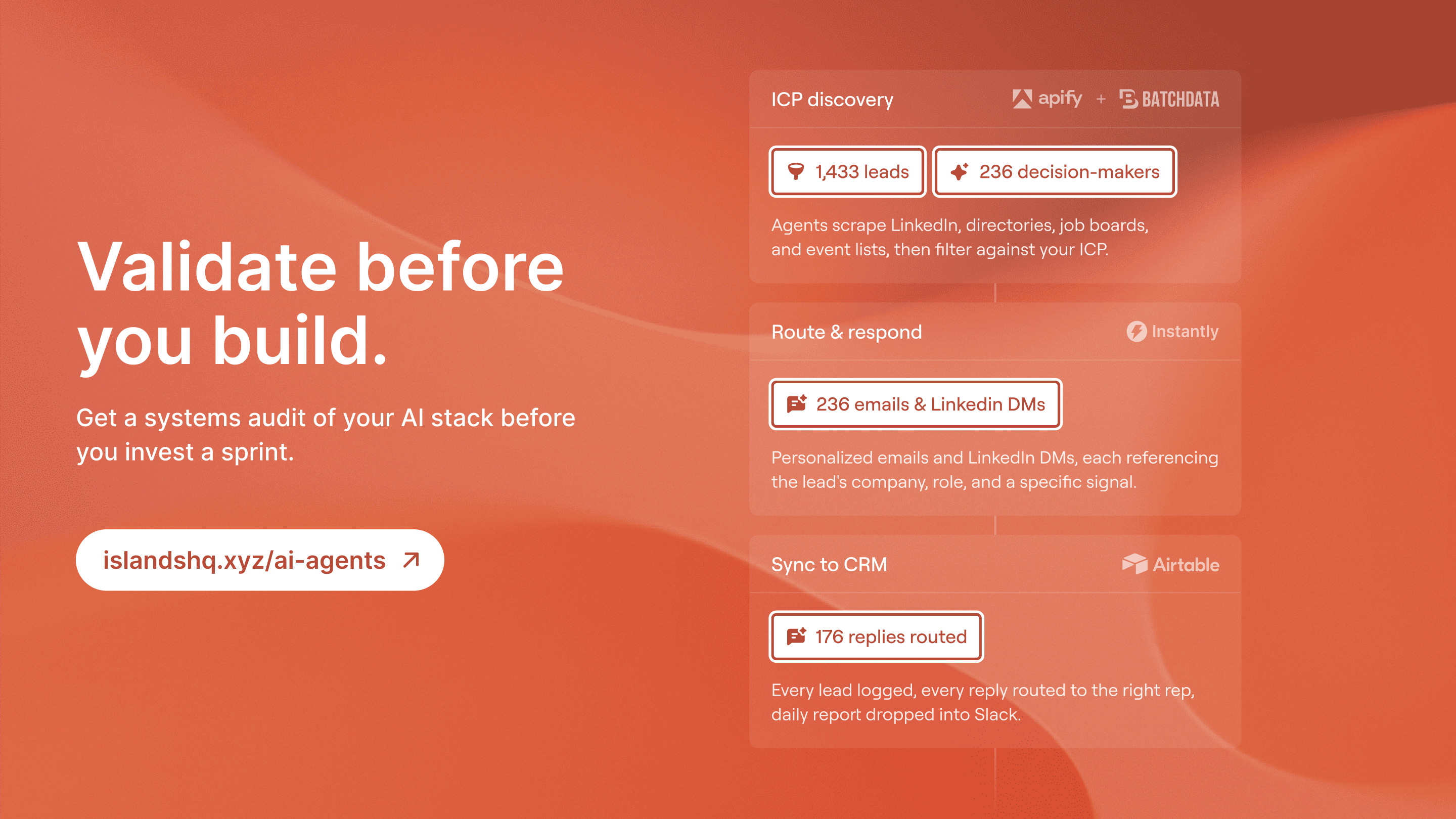
Move from assistants to agents with this playbook. Or reach out for a system audit. See if your AI ideas are ready for production.