
A Series B CTO I talked to recently was drowning in manual QA cycles. His team had several AI assistants but still couldn’t ship code fast. The intelligence was there, but orchestration wasn’t. Engineers were stuck in a sequential loop, managing every hand-off between tools themselves. That’s the Pilot Paradox: your engineering team scales linearly with your operational debt. Break the cycle with professional AI agent development.
For AI-native founders, basic intelligence is table stakes. The differentiator is moving from simple wrappers to agentic systems that operate as parallel worker fleets. By Q1 2026, 80% of new enterprise applications will embed at least one AI agent (Gartner). For venture-backed startups that want to survive the next growth cycle, that is the default architecture, not an edge play. Building on stateless assistant architecture means building on a weak foundation.
The architectural trap of the simple assistant
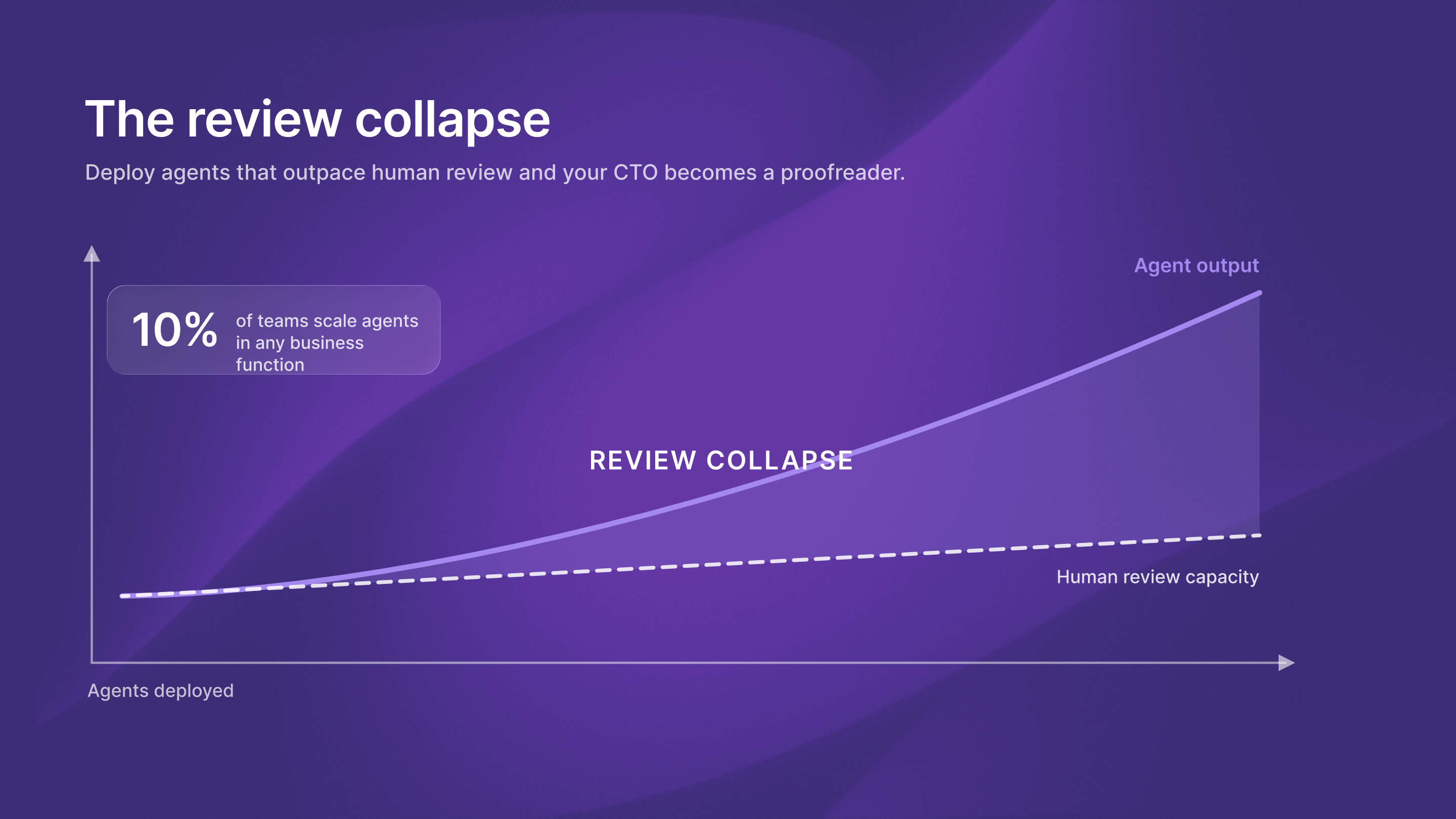
Most startups build thin wrappers around frontier models. Those wrappers come with immediate technical debt: no persistent memory, no state management. Without those, complex multi-step operations are impossible. Rely on a single assistant and you’re stuck in sequential processing. Step A happens, a human validates, then step B starts. The management tax scales with every new customer.
That linear approach is a relic from older software design. Treat AI as a series of disconnected chatbots and you lose the ability to handle high-concurrency workflows. Customer support or lead generation hits the ceiling of sequential processing fast. Without an orchestration layer, your engineering team spends more time managing the AI than building the product. You end up hiring more operations staff just to manage the automated tools. Growth-stage companies need to move from human-in-the-loop assistants to fully autonomous agentic workflows.
Modern AI agent development for scale
Moving past the prototype phase means adopting a systems-oriented architecture. For Series B-level AI agent development, the shift is toward parallel fleets. These fleets reason, plan, and act autonomously within defined guardrails. That means moving from basic prompt engineering to disciplined architectural infrastructure that supports long-term growth. Specialized AI coaching for founders can accelerate that transition from simple prompts to complex systems.
Engineering parallel fleets
Graph-based dependency tracking using directed acyclic graphs (Agents-Fleet) allows up to 12 parallel workers to work on sub-tasks at the same time. State persistence through long-lived memory layers ensures agents retain context across sessions. Specialized roles define distinct personas for agents: researchers, critics, and builders instead of one general-purpose model for every function. Standardized runtime layers use isolated environments for agent execution to ensure security and multi-tenant data protection. For data-heavy tasks, this includes designing robust web data tools with clear input schemas. Policy enforcement glue hard-codes the boundaries of what an agent can and cannot do before it reaches the model level.
Orchestrating parallel fleets vs. linear hiring
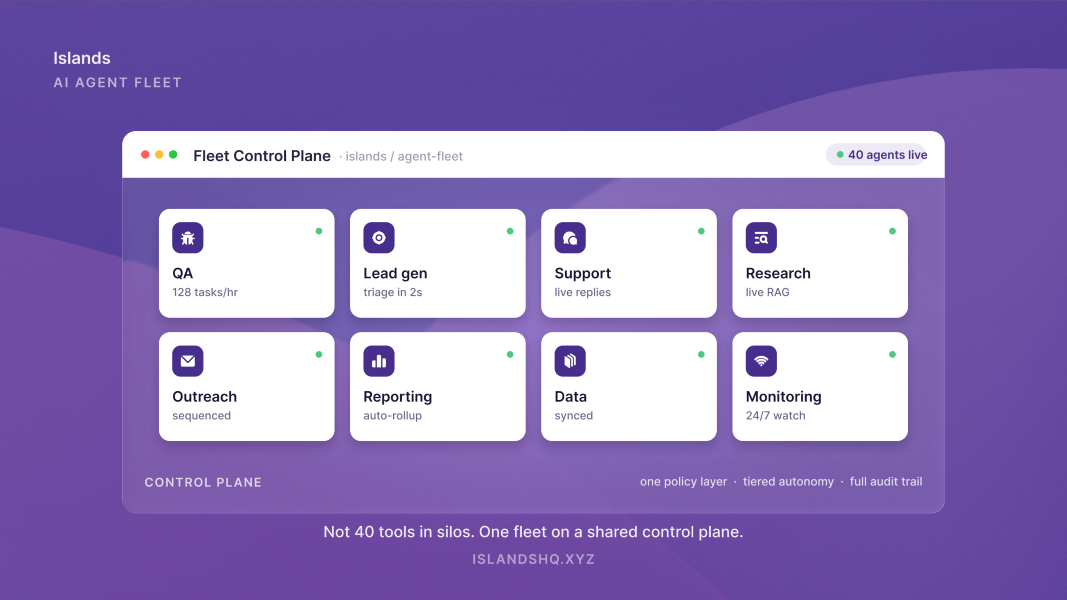
Founders debating between hiring more subject matter experts or investing in agentic AI systems should look at execution speed. A human-led team scales costs at a 1:1 ratio with headcount. An agent-augmented team coordinates groups of parallel workers using graph-based synthesis. That is a force multiplier: a small engineering core manages the output of a much larger virtual workforce. That architectural shift is essential for bridging the reliability gap between basic prototypes and production systems.
Implementing oversight in autonomous workflows
The primary objection to full autonomy is reliability. To address it, AI agent development frameworks must include policy enforcement and isolation glue. When standardizing operations for hundreds or thousands of customers (AWS), that becomes critical. For back-office functions, the direction is toward autonomous financial guidance and real-time detection systems.
Policy enforcement layers
Oversight means programmatic guardrails, not human-in-the-loop for every decision. With a shared runtime layer, you can enforce security protocols and audit every fleet action. That keeps agents in sensitive areas compliant. For lead generation or real-time financial forecasting, it’s the same. Adopting proven orchestration patterns early cuts the time to production-grade reliability.
Isolation glue for reliability
Scaling to thousands of customers demands strict multi-tenant isolation (AWS). Isolation glue prevents context from one customer bleeding into another’s reasoning loop. Founders should move toward task-specialized AI architecture instead of general-purpose monoliths. When an agent is isolated to a specific skill or data silo, debugging becomes a matter of logic, not hunting through a black box. That’s vital when building production-grade RAG pipelines that rely on clean, indexed data.
Action plan: deploying your first fleet
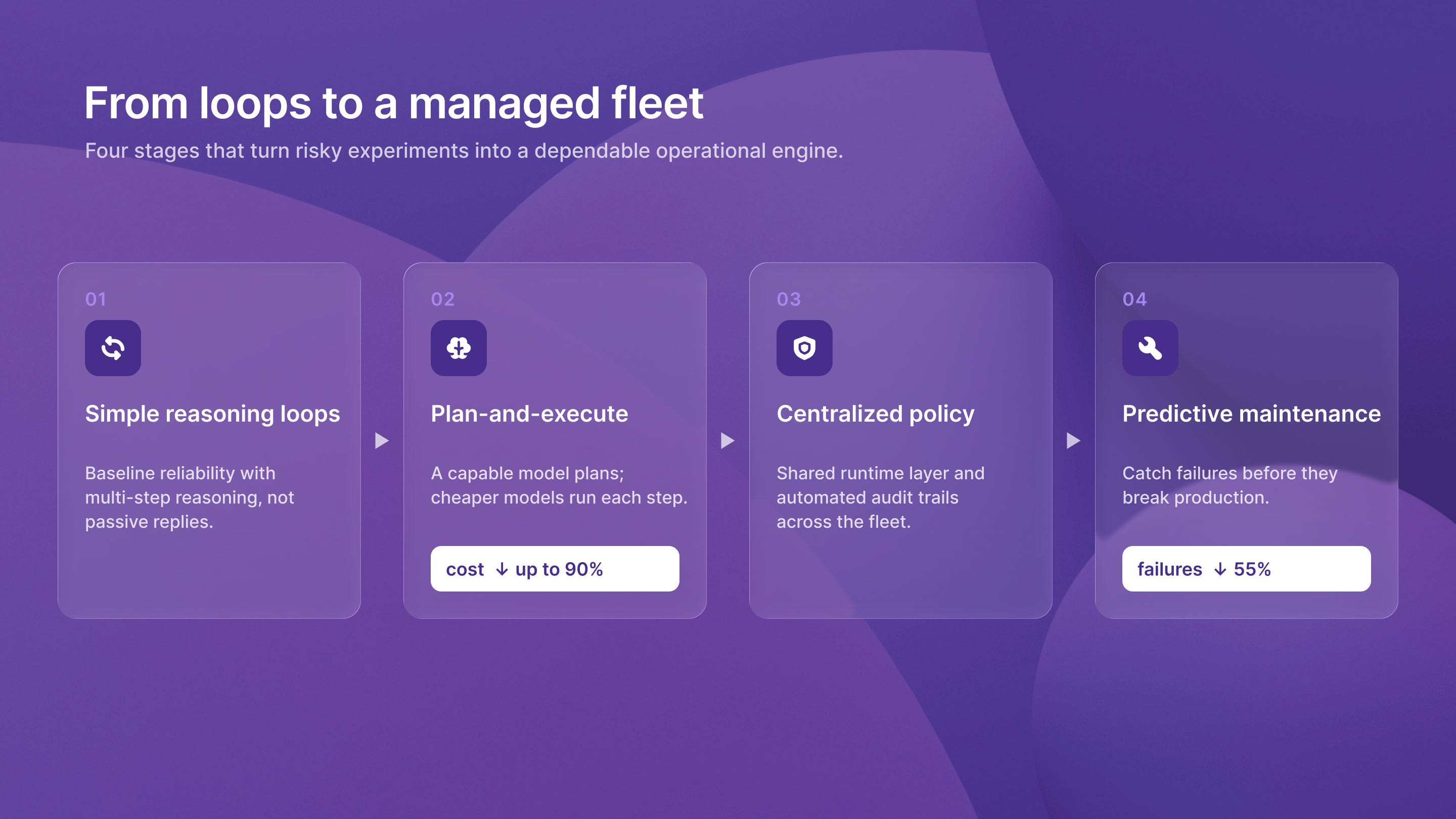
Moving from a proof-of-concept to a production fleet takes discipline. We focus on four steps. Start by identifying the bottleneck: the manual workflow that requires the most human hand-offs. That might be QA testing, which we’ve automated for our portfolio through qa flow, or the need to transition to an agentic CFO office. Define agent personas by breaking the bottleneck into specific roles, like an explorer to gather data and a critic to validate it. Implement graph-based orchestration using a coordinator agent to track dependencies and synthesize results from parallel workers. Deploy policy guardrails by building isolation glue and monitoring layers to ensure the fleet operates within your enterprise security standards.
Scaling through headcount belongs to a previous era. In 2026, growth speed depends on your ability to orchestrate autonomous systems. Moving to agentic fleets is essential if you want to avoid being crushed by operational costs. Scale your architecture or fail through your headcount.
Ready to scale your operations? Book a call with Islands today.