


I was talking to a CTO at a Series B fintech recently who realized their AI assistant was just a glorified search bar. They didn’t need a chatbot. They needed a digital employee. They were paying for a subscription to a tool that still required their team to do 90% of the manual labor. This is the core problem with the current state of SaaS: it’s still reactive. For growing startups, not adopting autonomous agentic workflows adds a management tax. This tax can slow long-term growth. Learning how to build AI agents for SaaS is now a requirement for engineering leaders who want to reclaim that lost time.
Building for the agentic era is the defining engineering challenge of the next two years. We are moving away from software that waits for a click. We are moving toward software that acts on behalf of the user. This is the shift toward Agent-as-a-Service architecture. To make this transition, you have to build agent-ready environments. These environments allow autonomous workflow systems to execute tasks independently by utilizing multi-step reasoning.
What we are seeing in agentic architecture
The market has shifted from simple wrappers to integrated orchestration. We’ve seen teams struggle with legacy setups that don’t allow for independent action. At Islands, we focus on building autonomous systems that replace entire workflows rather than assistants that merely enhance productivity.
Key results
Shift from reactive UI to proactive autonomous execution
Transition from human-centric APIs to machine-optimized documentation
Implementation of transparency layers for autonomous decision-making
Reduced management tax on senior engineering staff
How to build AI agents for SaaS: beyond the chatbot
Static software is a legacy asset. If your platform needs someone to log in for every action, it is not ready for the agentic Era. They should not have to open menus and click buttons each time. The architectural trap is building wrappers that fail to solve complex workflows. This usually happens because they lack the needed plumbing and a perception-only design. This design is hard to retrofit for true autonomy.
Moving from assistants to agents
An assistant answers questions. An agent finishes work. This requires a fundamental change in how you think about your application’s API strategy. Instead of building APIs for other humans to use, you are building them for agents. This means your documentation, error handling, and state management must be optimized for machine consumption. Companies building assistant architecture face expensive rebuilds if they later need autonomous capabilities.
The agentic loop vs. the command line
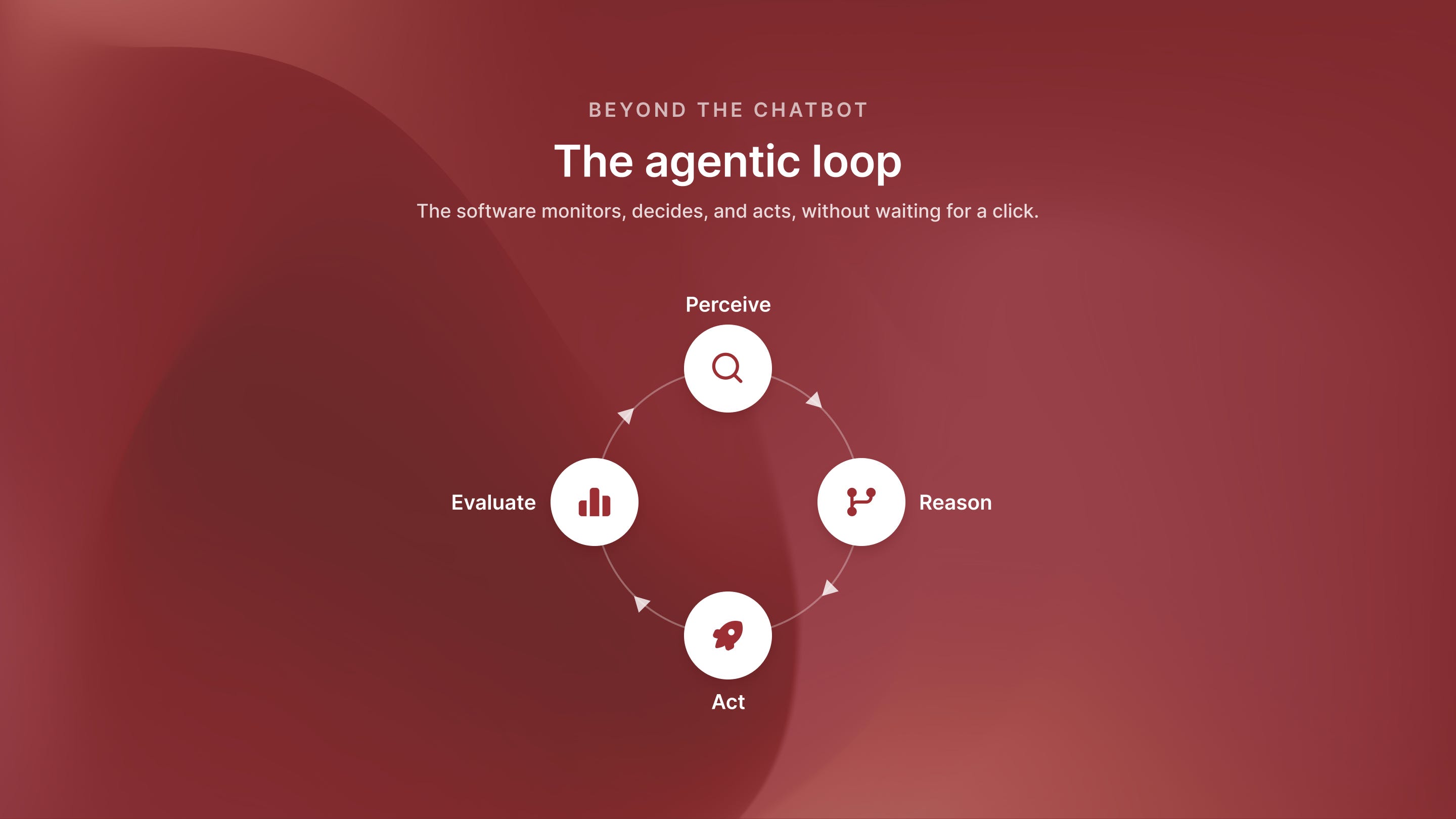
The goal is to create an agentic loop. This is where the software perceives a state, decides on an action, executes it, and then evaluates the result. This is much more than a command-line interface. It needs an AI agent orchestration layer. This layer can handle multi-step reasoning and integrate tools on its own. This helps achieve true process automation.
Designing for agentic experience AX
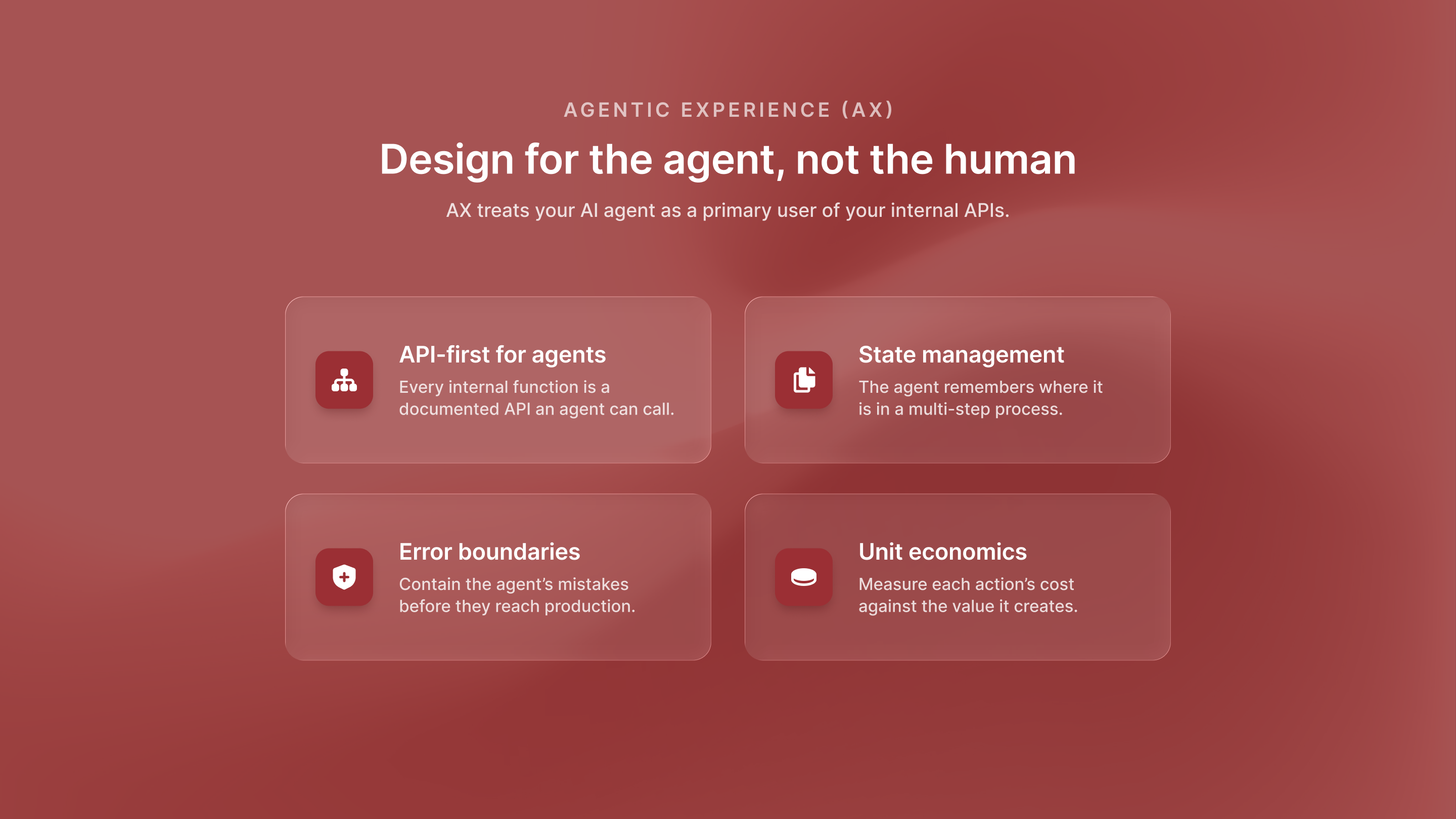
As software moves toward autonomous action, agentic experience AX is becoming a separate discipline distinct from traditional UX. You are no longer just designing for a human user. You are designing for the agent that serves them. Here is what we are seeing in AX design:
Proactive autonomy where the software suggests actions before the user asks
Transparency layers that explain the “why” behind an agent’s autonomous decision
Handoff protocols that define exactly when an agent should stop and ask for human help
Unit economics that track the ROI of each autonomous action compared to manual labor
How to build AI agents for SaaS: the implementation layer
Transitioning to Agent-as-a-Service architecture requires an environment that exposes internal APIs to autonomous agents for workflow execution. You cannot just slap an LLM on top of your existing UI and call it an agent. You need to build a dedicated orchestration layer. This layer acts as the brain. It manages context, handles RAG queries, and ensures that the agent doesn’t exceed its permissions.
We have seen that task-specialized AI architecture solves scaling and context bleeding problems that general-purpose models cannot. In a production-grade system, such as qa flow for autonomous testing, the agent isn’t just “testing.” It is managing a complex suite of APIs to simulate real user behavior. This is the level of technical rigor required for true autonomy.
30-day implementation roadmap
Identify one high-frequency manual workflow in your SaaS that currently requires 5+ clicks.
Expose the necessary internal APIs for that workflow to be executed programmatically.
Build a prototype agentic loop that can execute that workflow autonomously in a sandbox environment.
Define the “guardrails” and human-in-the-loop triggers for the agent.
Deploy the agent to a small group of power users and measure the reduction in manual task time.
The bottom line
The future is a dynamic workforce of digital employees. Static software is becoming a bottleneck to growth. A comprehensive AI audit is the first step to move from assistants to agents. If you are still building for human clicks, you are building a treadmill. It is time to move toward a compounding architectural asset.
Ready to transform your platform? Book a call with Islands today.