
I recently spoke with a Series B founder who was about to hire three full-time AI content specialists. I told him he was about to buy a very expensive architectural trap. He saw his content deficit as a headcount problem. He assumed that putting smart people in front of ChatGPT would build his pipeline. Understanding how to use a SaaS SEO content service is the first step toward avoiding this trap.
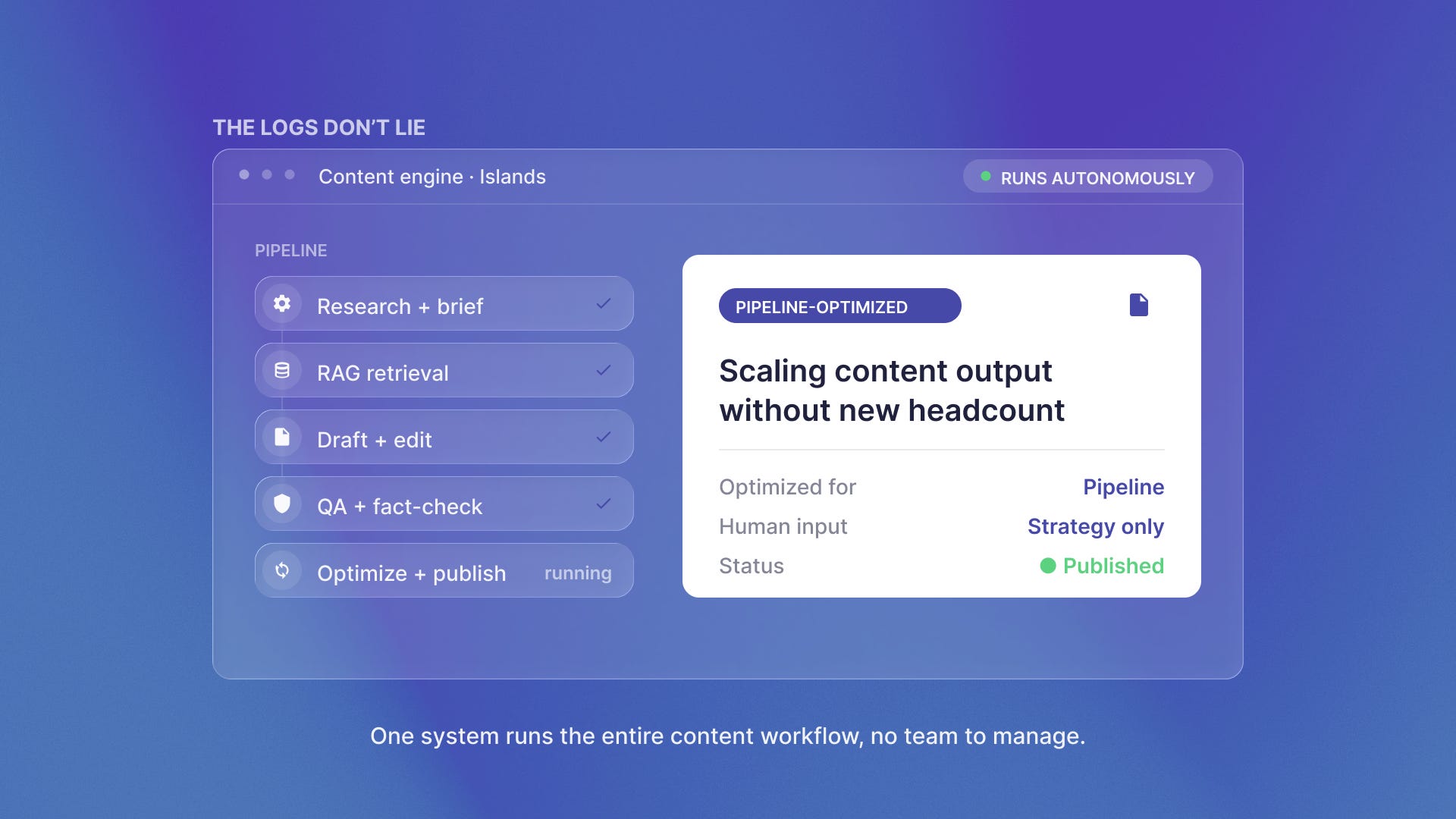
At the Series B+ stage, scaling means building a production-ready autonomous system. It does not mean hiring more people to do the work. For any Series B startup scaling its operations, the goal is to drive revenue without bloating the balance sheet. The logs don’t lie.
Most founders are at a crossroads. They know they must lead in search to cut customer acquisition costs, but they do not trust the old agency model. The temptation to build an in-house AI team is strong. The build model often collapses when you look at unit economics and long-term technical debt.
For an AI-native startup, agility is the ultimate ROI. Choosing a SaaS SEO content service instead of building in-house is a strategic choice. It focuses on coordination over manual work.
The unit economics of a SaaS SEO content service
When you decide to build an internal AI content team, the salary price is only the beginning. You are hiring for a new category of technical expertise that costs more in the current market. Your cost per asset increases once you factor in the full cost of these employees.
Strategic allocation for startups requires shifting from growth at any cost to AI infrastructure and automation efficiency. Agencies provide a lower total cost of ownership by eliminating the recruitment, benefits, and software costs found in internal expert teams (Discovered Labs). This efficiency is a core component of maximizing SaaS SEO ROI in a competitive market.
Consider the hidden costs that most founders overlook:
Recruitment fees for specialized AI talent
Health insurance, 401k matching, and payroll taxes
Seat licenses for specialized LLM tools and SEO platforms
Management bandwidth required to oversee a new department
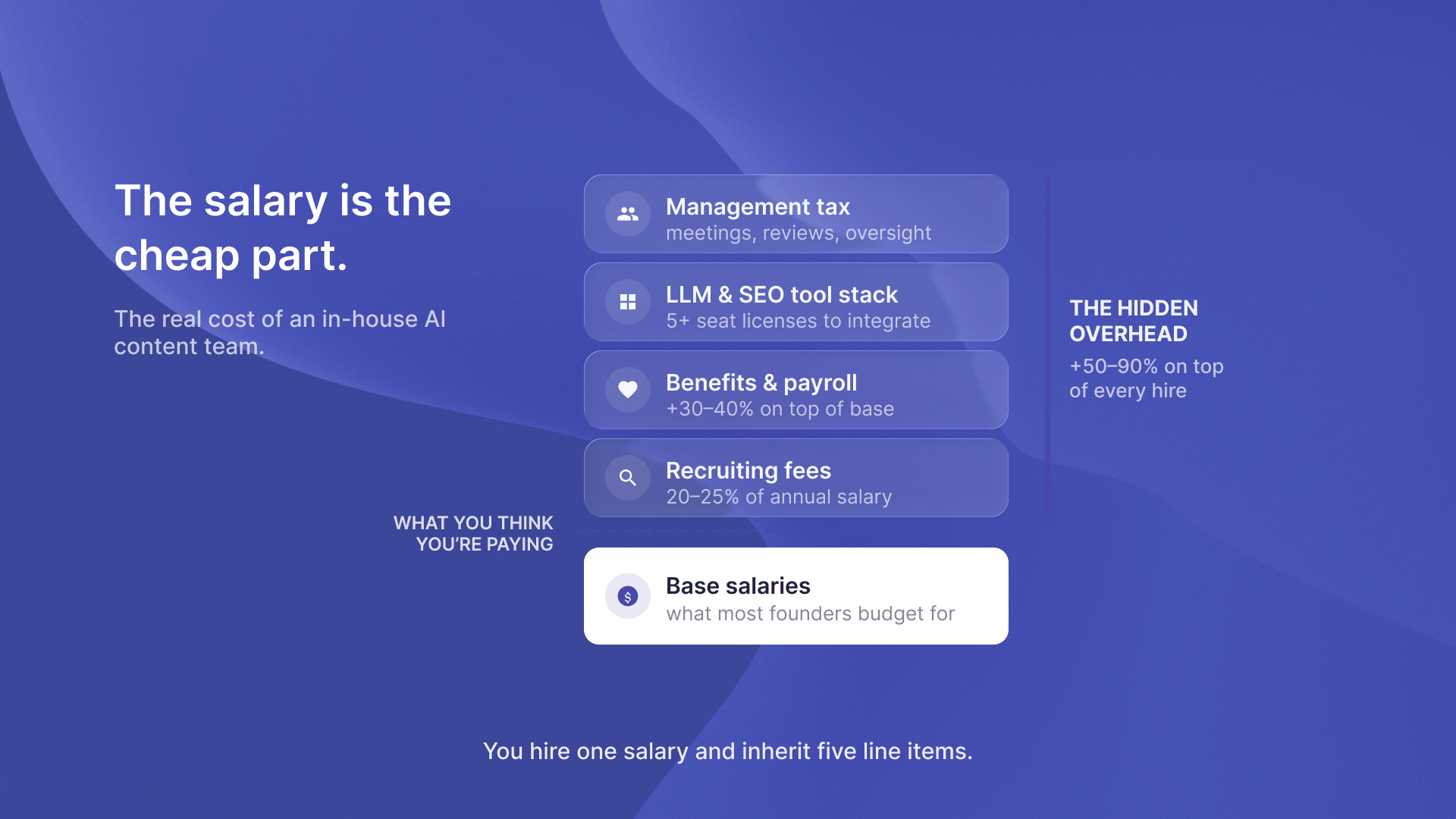
Beyond the raw numbers, there is the issue of software stack fragmentation. An in-house team usually stitches together five or six different tools to manage research, drafting, and optimization. This creates a manual overhead that cancels out the efficiency of AI. You end up paying human operators to act as the glue between disconnected platforms. This reflects a broader cost framework for startups where coordination overhead often makes traditional models fail.
Why in-house AI teams often fail to scale
The assistant vs. agent gap
Most internal teams use AI as a basic assistant. They use it to summarize notes or draft outlines, but a human still has to drive every step. This creates a linear relationship between your headcount and your output. If you want twice as much content, you eventually need more people to manage the prompts.
True scaling requires moving from assistants to autonomous AI agents that can handle multi-step workflows with minimal help. Building these agentic systems in-house requires deep engineering focus. Most marketing departments do not have that focus.
Technical debt in content workflows
When a marketing team builds its own AI workflows, they often lack the rigor of a dedicated engineering product. The result is technical debt. They build fragile prompts that break when the underlying model updates. They fail to build proper Retrieval-Augmented Generation (RAG) layers.
This leads to content that is generic or factually inaccurate. A specialized SaaS SEO content service avoids this by treating the content engine as a software product. This allows for specialized content agents to maintain high quality while increasing volume. Without this infrastructure, your team will spend more time fixing broken workflows than publishing content.
The performance-linked alternative
Successful SaaS SEO programs align their output with pipeline generation rather than search volume (Percepture). In a landscape where generalist content services are obsolete, a specialized service operates on a different economic model.
You are paying for outcomes and systems, not hours worked. This shift allows you to maintain a lean internal team. You benefit from a sophisticated orchestration layer that lives outside your balance sheet.
Feature comparison by model
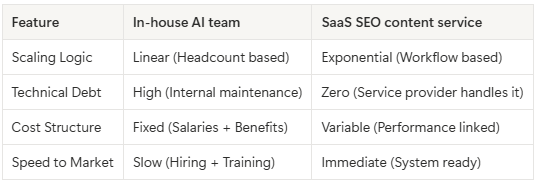
By using production-grade autonomous systems, you bypass the learning curve. You are plugging into a pre-built engine designed to turn technical authority into market share. This requires moving toward technical workflow pricing rather than human-plus-AI drafting. This is the difference between owning a car and hiring a logistics firm. One is a liability you have to maintain. The other is a service that delivers the goods.
The playbook: how to evaluate an AI-native partner
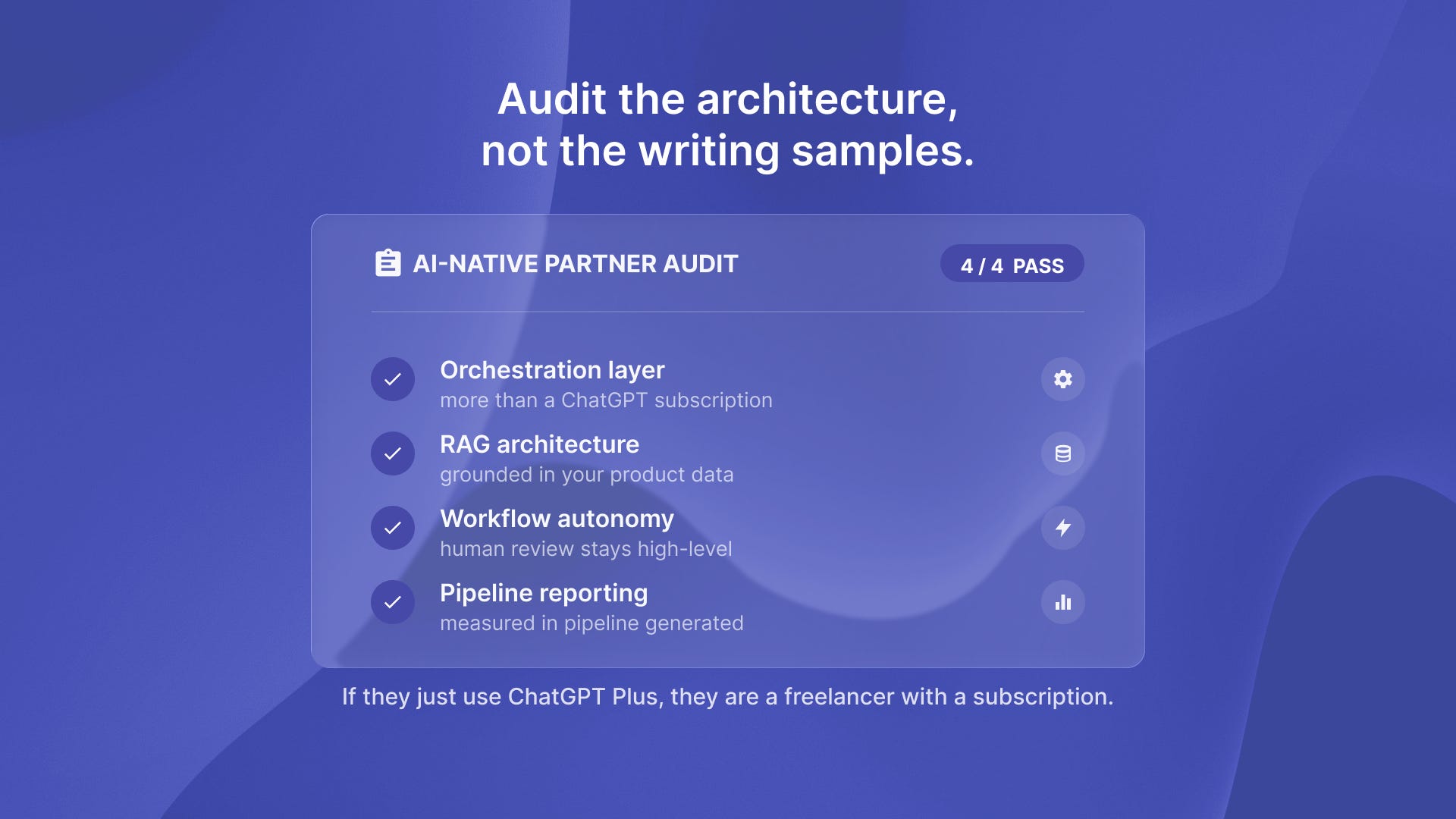
If you are moving away from the build model, you need to audit your potential partners. Look at their technical infrastructure. Do not ask for their writing samples. Instead, ask for their architectural diagrams. Here is how to evaluate them:
Audit their orchestration layer to ensure they are using agentic workflows rather than simple prompt engineering.
Verify their RAG implementation to confirm the AI has access to your specific product data and brand voice.
Request a breakdown of their unit economics. See how their costs match your pipeline goals. Use per-workflow architectural models.
Examine their history of maintaining technical integrity across model updates to ensure long-term stability.
Modern scaling involves an AI content operator managing LLM-driven workflows (REWORK). This increases output without sacrificing quality. When you find a partner that operates this way, you gain speed. Autonomous workflows are necessary to maintain market velocity and competitive moats.
The bottom line
For a Series B+ startup, every dollar must be an investment in scale. Building an in-house AI content team creates a management burden and a technical liability. This slows you down. A specialized SaaS SEO content service provides the infrastructure you need to dominate your market without the architectural debt. By choosing specialized technical systems over generalist headcount, you ensure that your content remains a high-ROI asset.
If you are ready to review your current content setup, we can help. Autonomous systems can improve your pipeline. Reach out today for an SEO technical audit.