


I’ve been watching something unfold that doesn’t get talked about enough in technical circles. The speed we’re getting from AI coding assistants is real. The productivity gains are legitimate. But there’s a point where fast iteration turns into costly architecture, and most teams don’t see it coming.
Cursor’s CEO said something recently that caught my attention. Vibe coding can build shaky foundations. Those foundations may crumble as you add complexity. He’s right, but here’s what he didn’t say: when that happens, why it happens, and what architectural patterns prevent the collapse.
I’m writing to you about this because I’ve watched both sides of this story play out. We’ve used vibe coding for prototyping across multiple projects. We’ve also built production autonomous systems that run unsupervised at scale. The difference between these two approaches isn’t incremental refinement. It’s a complete architectural shift that most teams miss until they’re deep in technical debt.
The vibe coding phenomenon is real
Let me be clear about something first: vibe coding works brilliantly for specific use cases. When you explore an idea, AI-assisted development can change how you work. When you confirm a concept, it can change how you work. When you build a prototype to test assumptions, it can change how you work. You can iterate in hours instead of days. You can test multiple approaches simultaneously. You can move from concept to working demo faster than ever before.
Last month, I watched a team at one of our portfolio companies use Cursor. They prototyped three different interface approaches for the QA flow in one afternoon. Each prototype was functional enough to test with real users. That kind of velocity was impossible two years ago. The tool enabled exploration that led to better product decisions.
But here’s where things get interesting. That same team tried to take one of those prototypes into production. They added complexity: real user data, edge cases, error handling, state management. Within two weeks, they were rewriting from scratch. The architecture that worked for the prototype couldn’t support production requirements.
This isn’t a failure of the tool. It’s a mismatch between design patterns that support fast updates and patterns that support stable production systems.
The hidden cost of AI-Generated code
The numbers tell a story most teams aren’t tracking. 24.7% of AI-generated code contains a security flaw. 70% of developers spend extra time debugging AI-generated code. These aren’t theoretical risks. They’re production realities that compound at scale.
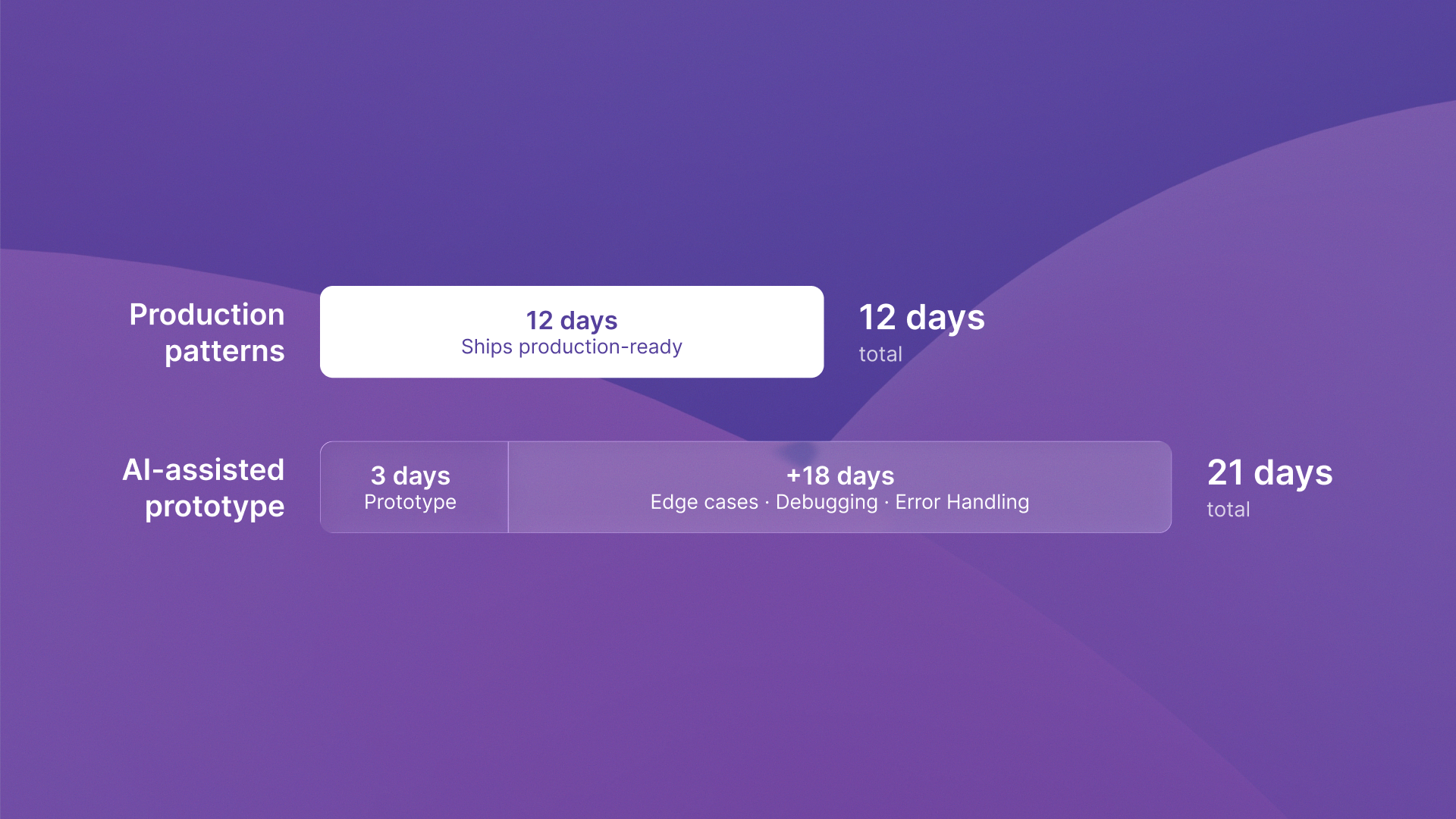
I was talking to the engineering team at ReachSocial about their LinkedIn automation platform. They ran an experiment: build a feature with vibe coding versus traditional development. The vibe coding approach delivered a working prototype in 3 days. The traditional approach took 12 days. Clear winner, right?
Not quite. When they deployed the vibe-coded version to production, they spent 18 days fixing edge cases. They debugged unexpected behavior and added error handling that was not in the first version. The traditional approach shipped with those patterns built in from day one.
The productivity gain in the demo phase became technical debt in the production phase. Fast iteration traded long-term maintainability for short-term velocity.
What production systems need that prototypes don’t
Here’s what I’ve learned from deployments across our portfolio: production-ready autonomous systems require fundamentally different architecture than AI-assisted prototypes.
Let me break this down with specific patterns:
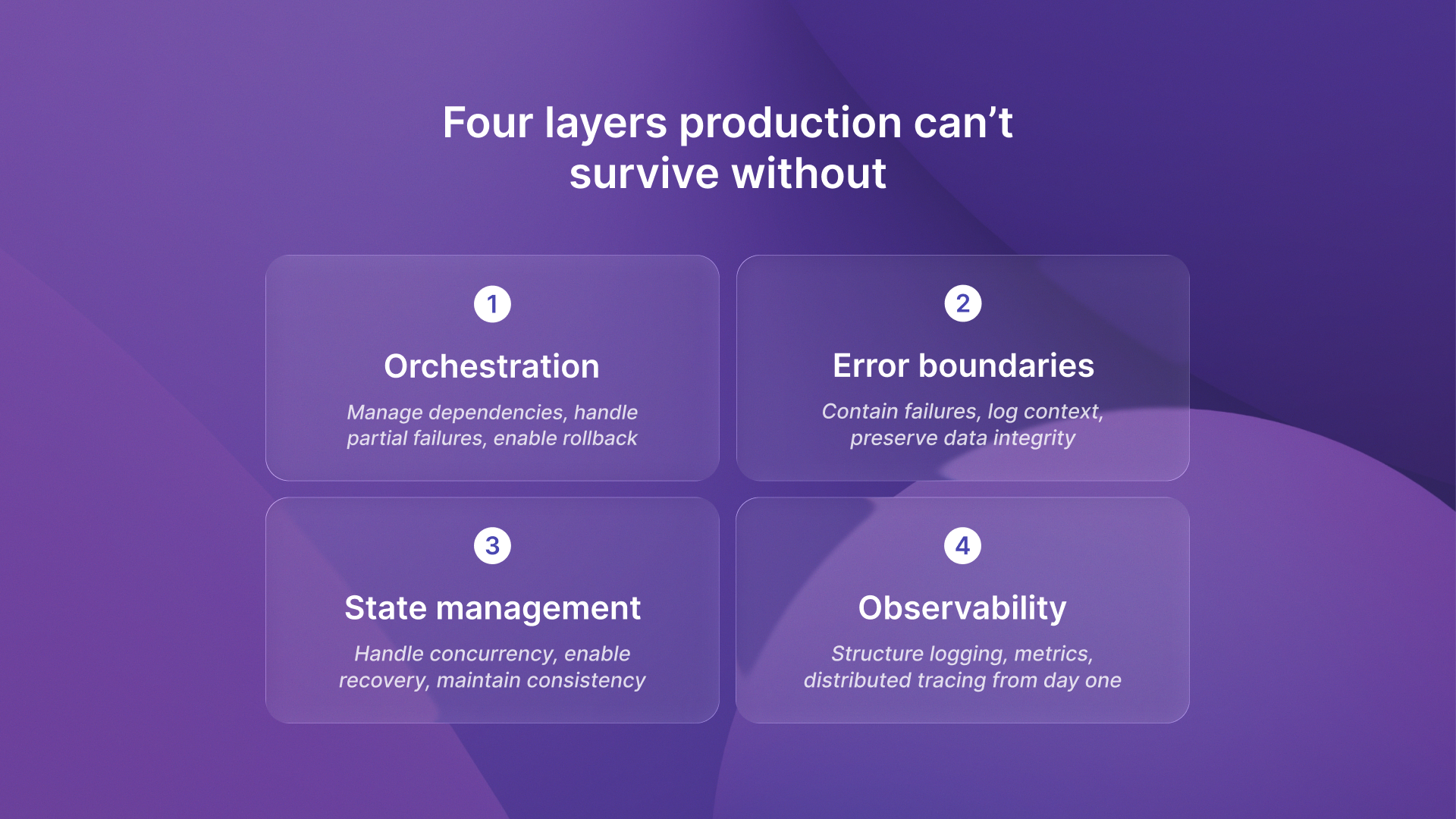
Orchestration layers: Prototypes chain functions together directly. Production systems need orchestration that manages dependencies, handles partial failures, and enables rollback. When QA flow runs regression tests on its own, the orchestration layer prevents failures in test generation. It also ensures test execution still runs. Vibe coding workflows typically skip this layer entirely.
Error boundaries: Prototypes crash and restart. Production systems need error boundaries that contain failures, log context, and enable recovery. We learned this building Timecapsule. Real-time profitability monitoring can’t just fail when an integration hiccups. The system needs error boundaries that preserve data integrity while degrading gracefully.
State management: Prototypes use local variables and hope for the best. Production systems need explicit state management that handles concurrency, enables recovery, and maintains consistency. This isn’t academic theory. It’s the difference between a demo that works in testing and a system that runs unsupervised in production.
Observability hooks: Prototypes log to console. Production systems need observability from day one: structured logging, metrics collection, distributed tracing. Without these hooks, you’re debugging production issues blind.
These patterns aren’t optional refinements. They’re the architectural foundation that separates sustainable systems from collapsing prototypes.
I’ve written before about why autonomous agents deliver better ROI than assistants. The architectural difference matters. Assistants enhance human workflows. Autonomous agents replace them entirely. You can vibe code an assistant that helps a developer write tests. You can’t vibe code an autonomous agent that generates, executes, and maintains regression tests without human intervention.
Companies that build for production now will get an 18-month head start. Competitors will still be rewriting their vibe-coded prototypes. That timeline matters. The teams building with production patterns today are learning lessons that can’t be compressed into faster iteration cycles.
This is where proven playbooks beat expensive experimentation. We’ve deployed autonomous systems in production. We know which patterns prevent collapse and which accelerate it. That knowledge comes from live deployments at scale, not theoretical architecture discussions.
The path forward
If you use AI coding assistants today (and you should), separate prototype architecture from production architecture in your plan. Ask explicitly: are we exploring or are we shipping?
If you’re exploring, embrace vibe coding. Move fast. Test assumptions. Learn quickly.
If you’re shipping, architect for production from day one. Build orchestration layers. Implement error boundaries. Design state management. Add observability hooks.
And if you’re moving from exploration to production, plan the rebuild. Don’t try to refactor a prototype into a production system. The architectural foundations are too different.
The speed of AI-assisted development is transformative. But speed without sustainable architecture becomes technical debt. The companies that understand this distinction are the ones building systems that scale.