
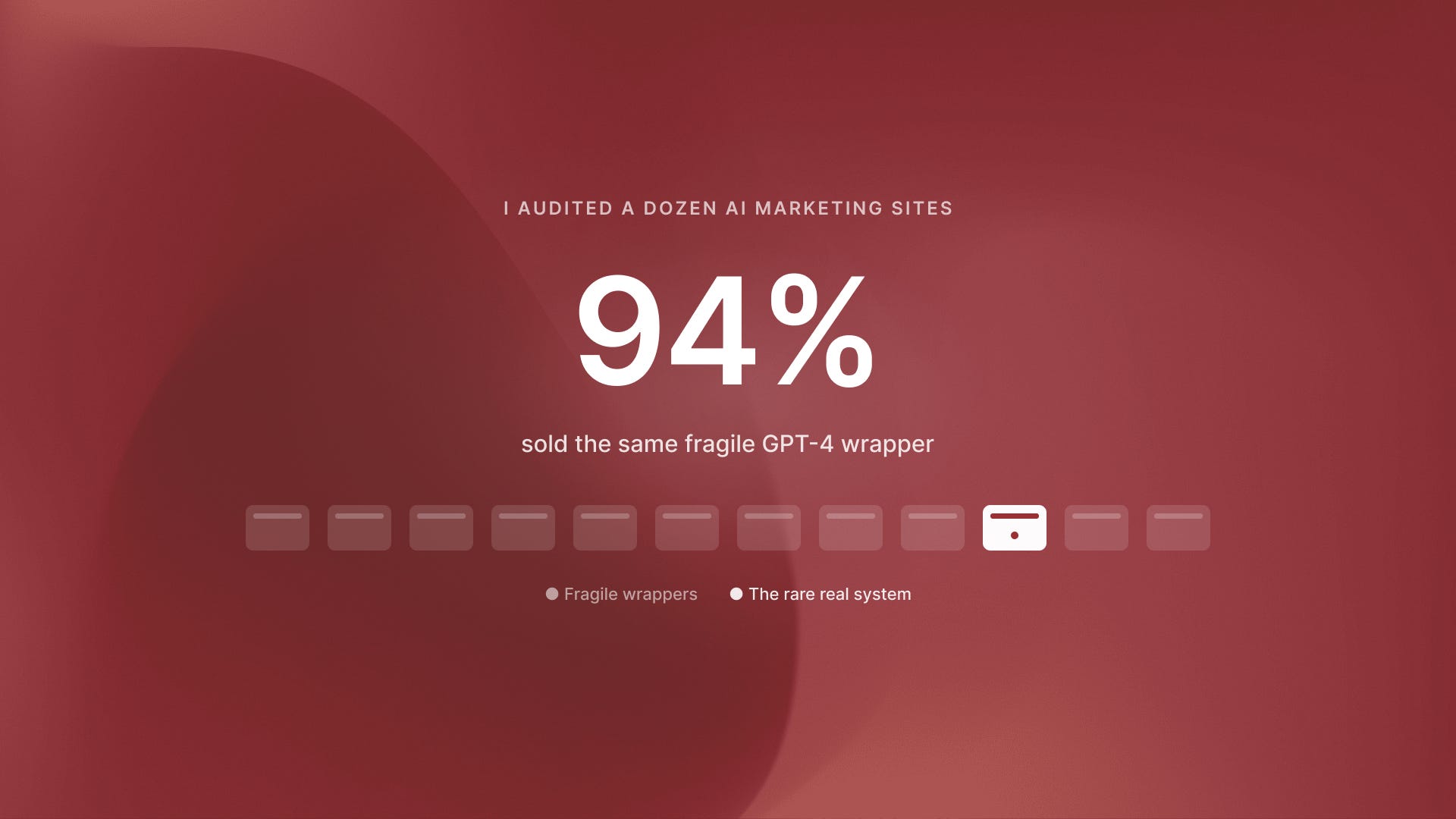
A founder asked me last week why his automation rollout felt like a high-maintenance science project. He had spent $50,000 with a boutique agency to automate his sales development. Three months later, the system was a brittle mess of disconnected Zapier hooks and fragile prompts. It broke every time a lead replied with a typo. I decided to dig deeper. I spent the weekend reviewing the services of over 1,000 firms that claim to be an AI marketing agency. The results were consistent. 94% are making the same structural mistakes that lead to project failure.
The market is currently saturated with ‘prompt engineers’ posing as systems architects. They know how to talk to a model, but they don’t know how to build a production-grade system. For technical leaders, the gap between hype and infrastructure is wider than ever. This is the core problem in AI digital marketing today.
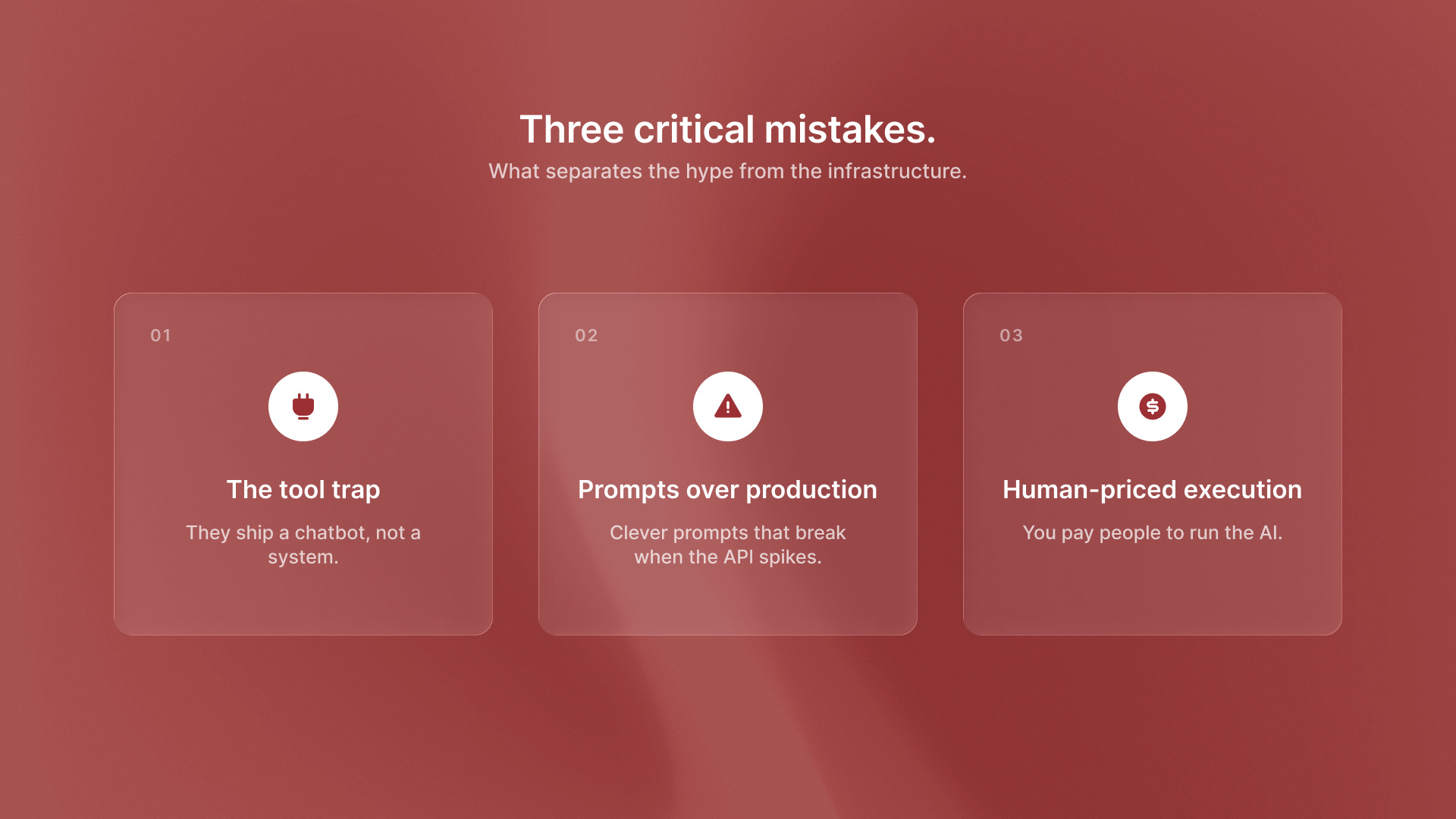
Mistake 1: selling surface-level tools instead of integrated systems
The first mistake is the ‘Tool-Provider’ trap. Most agencies essentially resell a stack of third-party SaaS products with a thin layer of configuration. They focus on ‘what tool to use’ rather than ‘how the data flows.’ This approach leads to fragmented workflows. The AI becomes a fancy feature rather than a core operator. An AI website marketing agency should prioritize these deep integrations over simple tool subscriptions.
Kent Beck, the software engineer whose Extreme Programming methodology reshaped how modern engineering teams think about the difference between shipping features and shipping systems, said it in a line every CTO should apply to AI vendor evaluations:
“Make it work, make it right, make it fast.” - Kent Beck, creator of Extreme Programming
When you hire an agency, you aren’t looking for a list of AI marketing tools. You are looking for a system that can reason across your entire business.
Surface-level tools help you write a LinkedIn post.
Integrated systems identify high-value prospects and analyze company filings.
Autonomous agents draft personalized reach-outs and update CRM data.
The difference: one is a productivity hack, the other is infrastructure.
Businesses often fail when they rely on manual prompting rather than building agentic workflows. Many teams struggle with marketing operations manager time consuming tasks ai automation 2026 because they lack this systemic approach.
Mistake 2: ignoring the unit economics of human-centric models
The second mistake is economic. Many agencies still try to run a traditional human-centric model while charging premium prices for AI. They use AI to speed up their own internal work. However, they still bill based on hours or human-led deliverables. This is a fundamental misalignment of incentives.
David Heinemeier Hansson, the creator of Ruby on Rails and co-founder of 37signals whose Rework and It Doesn’t Have to Be Crazy at Work have shaped how modern executives think about honest labor economics, said it in a line every founder evaluating an AI agency should keep close:
“Working more doesn’t equate to caring more, or getting more done.” - David Heinemeier Hansson, co-founder of 37signals
The point of AI automation is to break the link between headcount and output. If an agency doesn’t reflect this in its pricing, they are likely just using AI as a buzzword. A true ai marketing agency shows you how their system reduces your costs by orders of magnitude. A 10% improvement is not enough.
We see this in firm-wide utilization benchmarks. If they still advertise “dedicated account managers” as their main value, they have not adapted to autonomous operations.
Mistake 3: lacking production-grade stability and business logic
The third mistake is the architectural gap. Most AI implementations are built on ‘happy path’ logic. They work perfectly when the input is clean. But production environments are messy. Real leads give weird answers. APIs have downtime. Models hallucinate.
Charity Majors, the co-founder and CTO of Honeycomb whose work on observability engineering has become the operating manual for how modern engineering teams think about production reliability, put the case for production-grade thinking more directly than anyone:
“You can only debug what you can observe.” - Charity Majors, co-founder and CTO of Honeycomb
An AI automation agency that ignores error handling, data checks, and logic loops is building a house of cards. Scaling AI requires production stability. This means building systems that can identify their own failures and self-correct. We see this in the architecture of platforms like ReachSocial or QA flow. These aren’t just wrappers. They are hardened engineering systems designed to run 24/7 without human supervision. They often start with an AI automation agency website layout that converts clients by demonstrating technical reliability.
Signs an agency lacks production-grade logic
No mention of data integrity or CRM synchronization.
Reliance on ‘one-shot’ prompts for complex tasks.
No clear path for handling ‘low-confidence’ AI outputs.
Lack of a testing framework to validate agent actions before they go live.
The playbook: how to audit an ai marketing agency
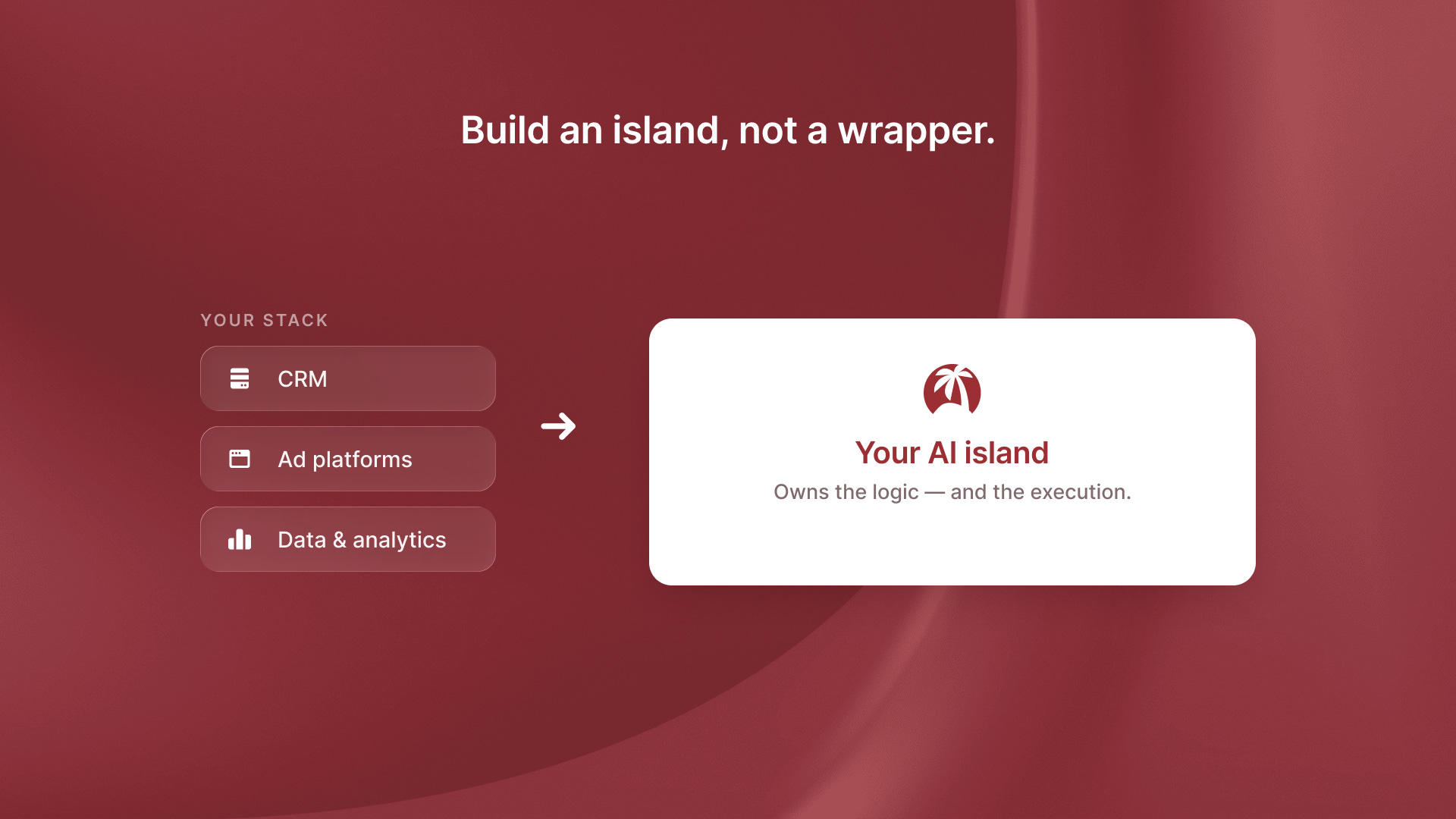
If you are a CTO or founder, you need a different set of questions to vet a partner. You are no longer looking for a creative agency. You are looking for a technical integrator who understands marketing. This requires the ‘AI Island’ approach. You want a team that builds self-contained autonomous environments. Specialized AI conversational marketing agency website development is often the first step in creating these environments.
The questions you should be asking
How does your system handle data validation before it reaches the model?
What is the process for monitoring and retraining agents based on real-world performance?
Can you show me the logic flow for an agent that handles three or more different business tools?
How do you measure the ROI of the system beyond just ‘time saved’?
I’ve found the best builders don’t talk about prompts. They talk about infrastructure. They focus on automating the repetitive tasks that eat your team’s time. They focus on the ‘unit economics’ of the agent. This includes sustaining daily LinkedIn engagement without manual overhead.
Why you need architects of autonomy
The shift in 2026 is moving away from the ‘consultant’ who tells you what to do. It is moving toward the ‘builder’ who constructs the machine. The goal is to create a system that becomes a permanent asset for your company. This is why we advocate for systems over manual production.
When we build these systems, we aren’t looking for a cool demo. We are looking for something that can handle thousands of leads a month without breaking. If an agency cannot show a live system running for 90 days without a major failure, it is still in “prompt engineering.”
The bottom line
Don’t be fooled by a clean website and a few clever prompts. The real value in AI marketing news is the move toward architectural integrity. 94% of the agencies out there are selling projects. You need a partner who builds infrastructure.
The shift from ‘hiring an agency’ to ‘building an AI island’ is a major strategic move for a technical leader. It is the difference between a high-maintenance experiment and a scalable business advantage.
Build. Run. Maintain.
If you are tired of fragile wrappers and want to build a production-grade AI system, book a call with our team today.