


Hey friends 👋
Quick field note from Web Summit Vancouver this week.
We brought a spin-the-wheel.
Bright lights. Loud clicks. Prizes ranging from free strategy sessions to a full Build Week where our team builds the winner an agentic system from scratch.
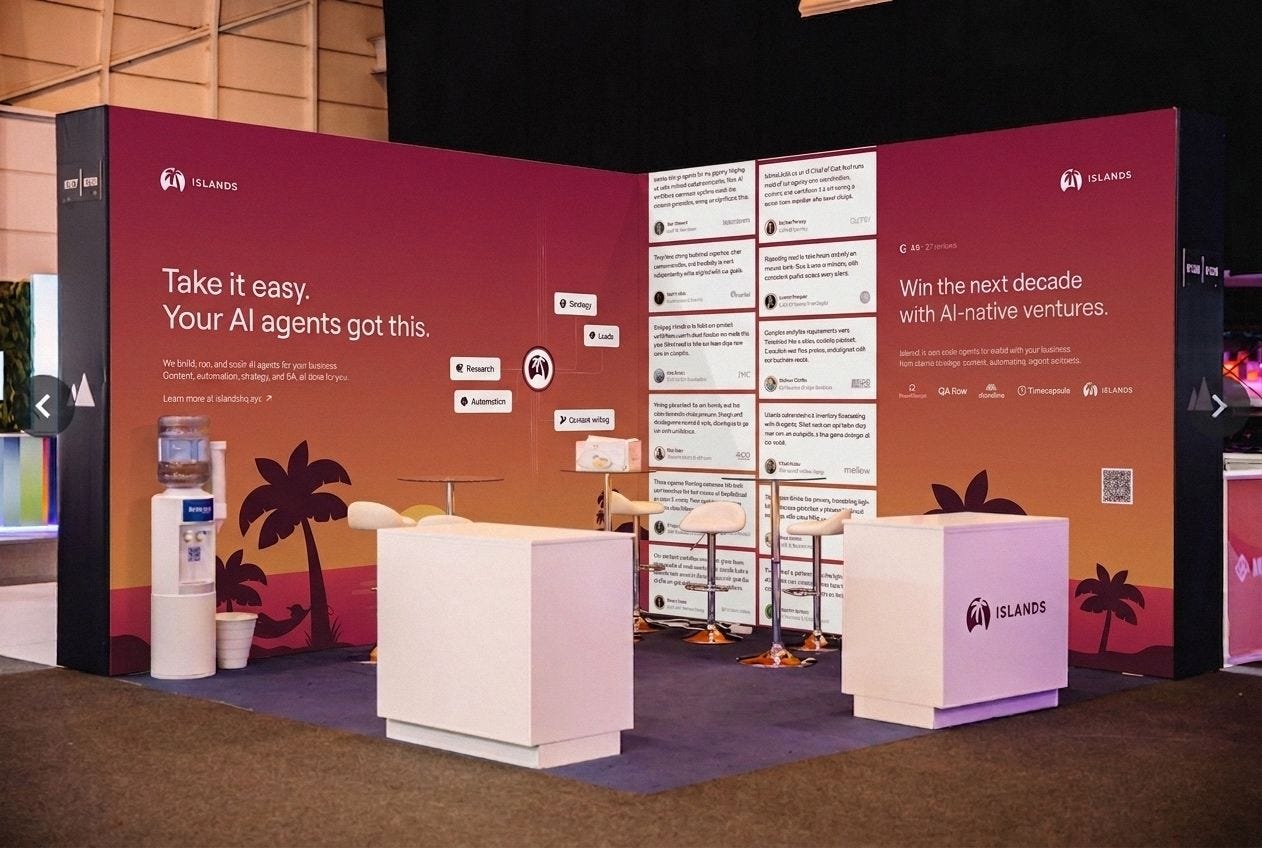
Final tally:
90 people spun it
79 walked away with free or discounted agent services
3 won full Build Weeks with the Islands team
The wheel did what wheels do.
But that’s not what I want to write to you about today.
The interesting part wasn’t the wheel
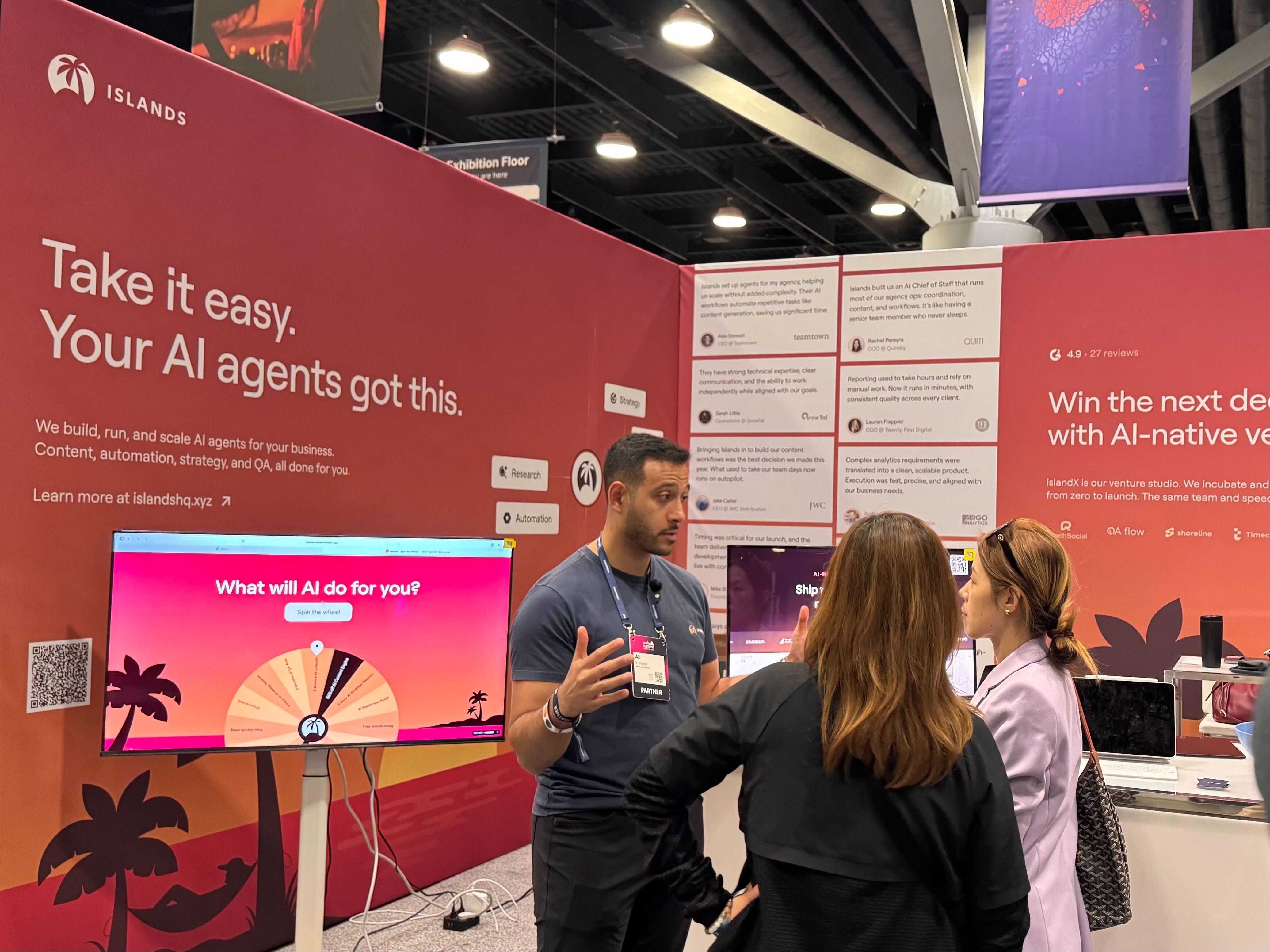
It was the question that kept getting asked. Almost word-for-word, dozens of times, from founders, operators, and execs walking the floor:
“Wait - you actually build agentic systems? Like, real ones?”
Yes. That’s exactly what we do.
And the fact that this question kept landing is, honestly, the most important signal I’ve taken away from any event this year.
Here’s what I mean.
The word “AI” has lost almost all its information value
Think about how many things are currently called “AI”:
A wrapper around GPT that summarizes a meeting
A chatbot on a marketing page
A spreadsheet plugin that drafts emails
A multi-agent system that runs an entire content operation end-to-end
A QA engineer that catches regressions before they hit production
An autonomous workflow that triages tickets, qualifies leads, books meetings
These are not the same thing. They’re not even the same category of thing.
But on a conference floor, all of them say “we use AI.”
So when a stranger at a booth says “we build agentic systems,” the natural reaction is to assume it’s marketing. Another chatbot. Another wrapper. Another deck.
What kept landing in our 90 conversations was the actual distinction:
Generative AI gives you a draft. Agentic AI does the work.
If a system writes you something and you read, edit, and post it - that’s generative. You’re still doing the job.
If a system can plan and do research, it is agentic.
If it can carry out tasks and recover from mistakes, it is agentic.
If it can measure results and only asks you for help when needed, it is agentic.
The work is happening without you.
That’s the line. And until you’ve seen one of those systems running on your own business, the difference sounds like marketing semantics. Once you have, it’s the only distinction that matters.
What we’re actually building
Quick context for newer readers:
Islands is a product and venture studio. We’ve accelerated 100+ companies since 2021. We build software and agentic systems for daring founders.
Our own AI Content System writes this newsletter. It is a multi-agent pipeline on n8n. It grew our Substack from 6 to 1,266 subscribers in 180 days. It took our QA flow Substack from 7 to 1,233 in the same window. Same system. Multiple brands. Zero content managers.
That’s the kind of thing we’re talking about when we say “agentic.”
It’s not a chatbot. It’s a system that runs while we sleep. It makes editorial decisions. It publishes to many platforms. It tells us how it did in the morning.
What I heard on the floor (3 patterns)
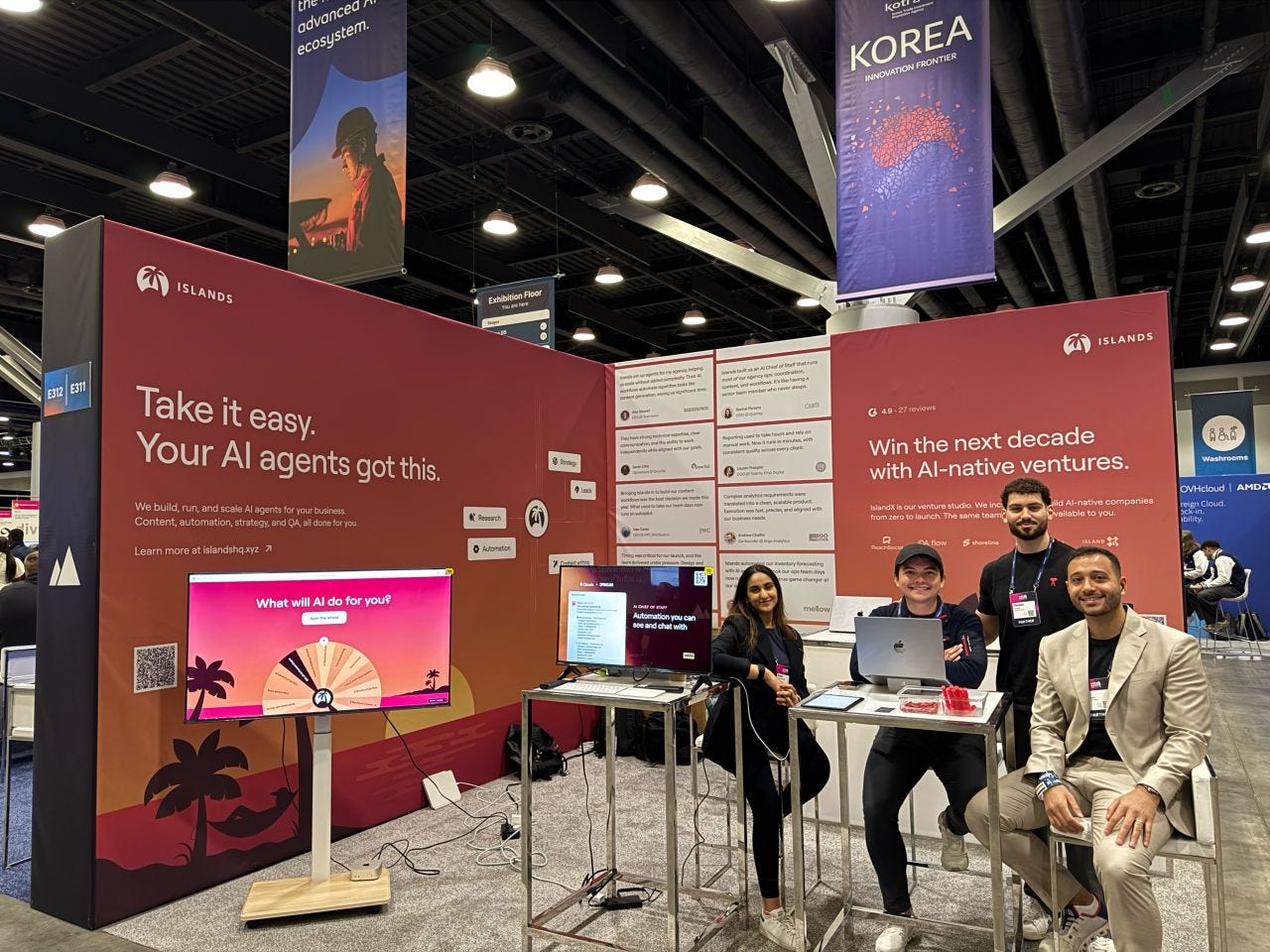
A few themes from 90 conversations, in case it’s useful:
1. Founders are post-tool, pre-system. Everyone’s tried ChatGPT, Claude, Cursor, Midjourney, n8n, Zapier. They know AI can do work. They want someone to assemble it into something that runs.
2. Operators want autonomy, not assistance. Nobody asked us for a better copilot. Everyone asked for a system that finishes the job. The era of “AI helps you do X” is giving way to “AI does X.”
3. Trust is the entire gate. The companies moving fastest aren’t the biggest or the best-funded. They’re the ones who’ve already shipped one agent into production and proven to themselves it works. The first one is the hardest. Every one after is easier.
What we gave away (and why)
Off the wheel:
AI Readiness Audits
Strategy sessions with our team
Months of free AI content
Three full Build Weeks - embedded engineering, custom agentic system from scratch
Why give that much away?
Because the bottleneck for most companies isn’t the budget. It’s never having seen one of these systems run in their own business. Once you watch an agent run your content calendar for a week or run your QA suite for a release, the talk changes. The hard part is just getting to that first “oh.”
The wheel was a faster way to get there.
The takeaway, if you only read this far
If you have an AI budget for 2026 and you have not deployed an agentic system yet, fix that next.
Not another tool. A system.
Something that runs without you. Something where you check in on results, not on progress. Something where the operating model of your company has shifted, not just one task on a list.
If you told me three years ago we’d run our own content engine on autopilot across five platforms, I’d nod politely. Then I’d doubt it in private. Today, we publish more, with higher quality, than we ever did with a human team. And that’s just one of the agentic systems we run for ourselves.
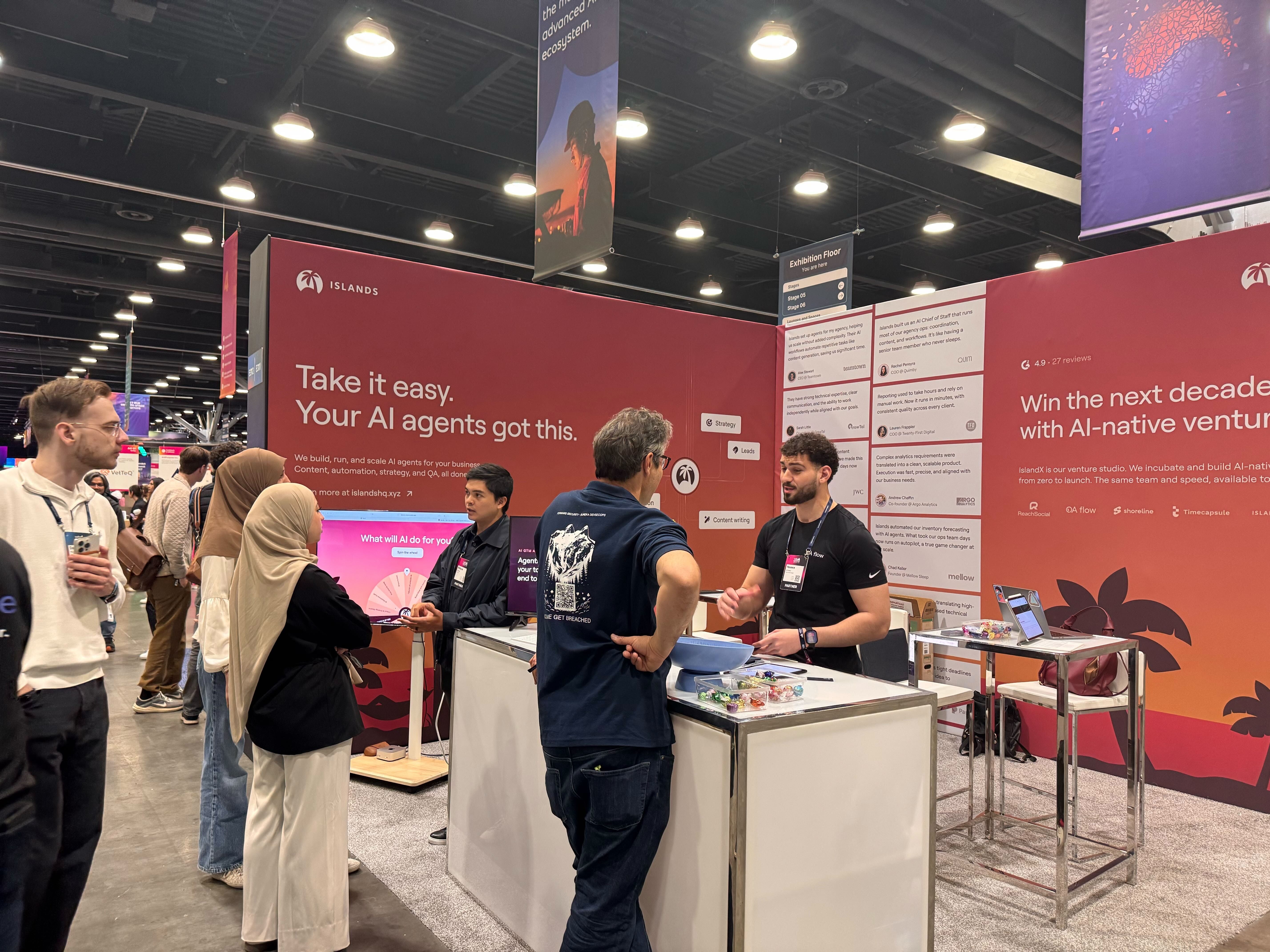
So when someone asks me at a booth, “wait, you actually build agentic systems?” — the answer is yes. And the more important answer is: and so could you, if you started.
If you missed us at Web Summit, you can still get a discounted AI strategy session. You can also get a content audit or an AI Readiness Audit. Same prizes, no booth required.
👉 Claim yours at islandshq.xyz/agencies →
No pitch. No hard sell. Just a real conversation about where agentic systems would replace your most painful repeatable workflow.
If this resonated, forward it to the founder in your life. They keep saying, “We need to do something with AI.” That can start the conversation.
Until next time, Ali El-Shayeb Founder, Islands Toronto 🇨🇦
P.S. - Want to see an agentic content system in real production?
Our own case study shows how we built ours, what it costs, and what it produces. The system that wrote this newsletter is documented there.