


I was reviewing a Series B infrastructure budget last week and the compute costs looked like a typo. They were not. For startups building production-ready AI, GPU time and infrastructure can quickly become very expensive. They can soon be the biggest cost after payroll. This is the reality of compute poverty in the current market. Securing Canadian tech implementation grants requires a strategic approach to non-dilutive funding to survive.
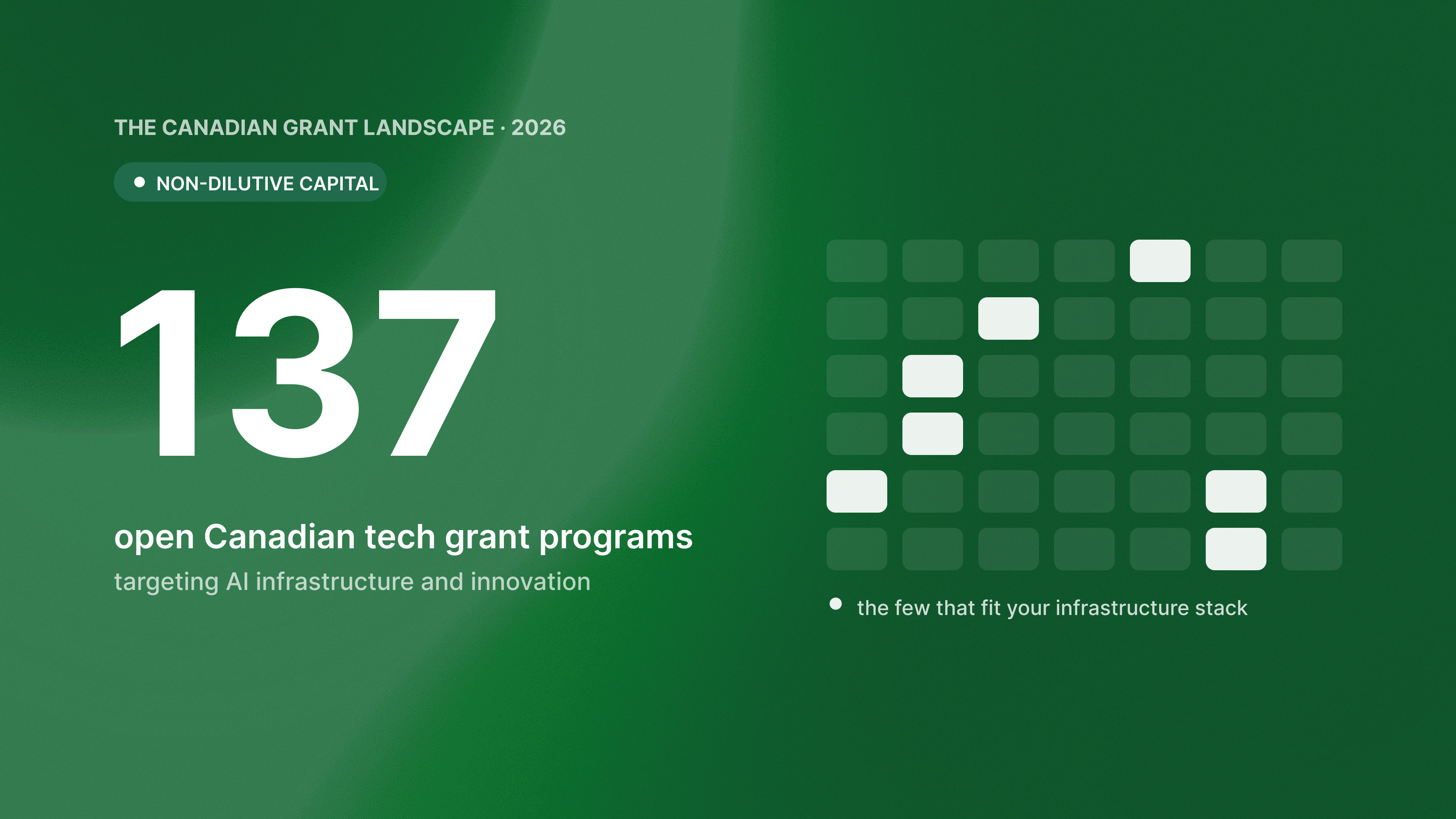
Canadian founders have a unique advantage if they know how to play the game. There are 137 open technology grant programs in Canada for 2026 targeting infrastructure and innovation (Grant Compass). These programs help companies implement the high-compute systems necessary for production-ready agent architectures to function at scale. Build. Run. Maintain.
The 2026 Canadian tech implementation grants landscape
The funding environment has shifted from general digital transformation to specific AI sovereignty. Infrastructure grants now cover much of the hardware and cloud costs for training and deploying large-scale models. Innovation grants focus on the novel application of these models to solve specific industry problems. Canadian tech implementation grants provide funds to bridge the gap between a successful pilot and a scalable global product.
Technical leaders must view these grants as a strategic financial lever. By securing non-dilutive capital for infrastructure, you preserve equity for future rounds while accelerating your technical roadmap. This is particularly important for startups where the infrastructure requirements for autonomous testing systems like QA flow are intensive. Managing these costs through grants allows for more aggressive experimentation without burning through your primary runway.
The AI compute access fund (ACAF)
The AI Compute Access Fund helps Canadian companies handle the high cost of AI infrastructure. It is an important option for managing these costs (Government of Canada). It is specifically designed to support companies that are moving beyond simple API calls and building proprietary autonomous systems. Many founders are finding that prioritizing technical bedrock is more critical than raw capital in this fast-moving market. Specifically, applying for AI infrastructure funding in Canada can help offset the rising costs of private GPU clusters.
Eligibility requirements for ACAF
To be eligible for high-compute projects under ACAF, you generally need to demonstrate:
A clear technical requirement for high-performance computing resources
A plan for how this compute will lead to commercialized AI products
A commitment to maintaining the technical bedrock within Canada
Detailed projections for how the infrastructure will scale with user growth
How to stack Canadian tech implementation grants
Capital efficiency relies on layering multiple funding vehicles to cover the entire lifecycle of your project. This requires a sequence that maximizes your return on engineering spend. To extend runway further, some firms use nearshore hiring strategies through Shoreline to manage structural costs alongside grant funding. NRC IRAP AI funding is often the first step for teams building complex machine learning models.
Secure NRC IRAP for the initial R&D. Use this to fund the engineering talent required to design your agentic architecture and prove the core logic.
Apply for ACAF once you have a technical proof of concept. Use this fund to cover the compute costs required to move that logic into a production-grade environment. You might also consider an orchestration layer to recycle workflows and compress deployment timelines.
Apply for regional development grants for the final implementation phase. These funds often cover the costs of bringing the product to market and scaling infrastructure for a global client base.
Managing reports across many vehicles is hard. But it is a necessary trade-off. It helps secure millions in non-dilutive capital. You need a system that tracks engineering hours and compute spend. This system must satisfy the audit requirements of each program simultaneously.
Moving from grant-funded demo to production
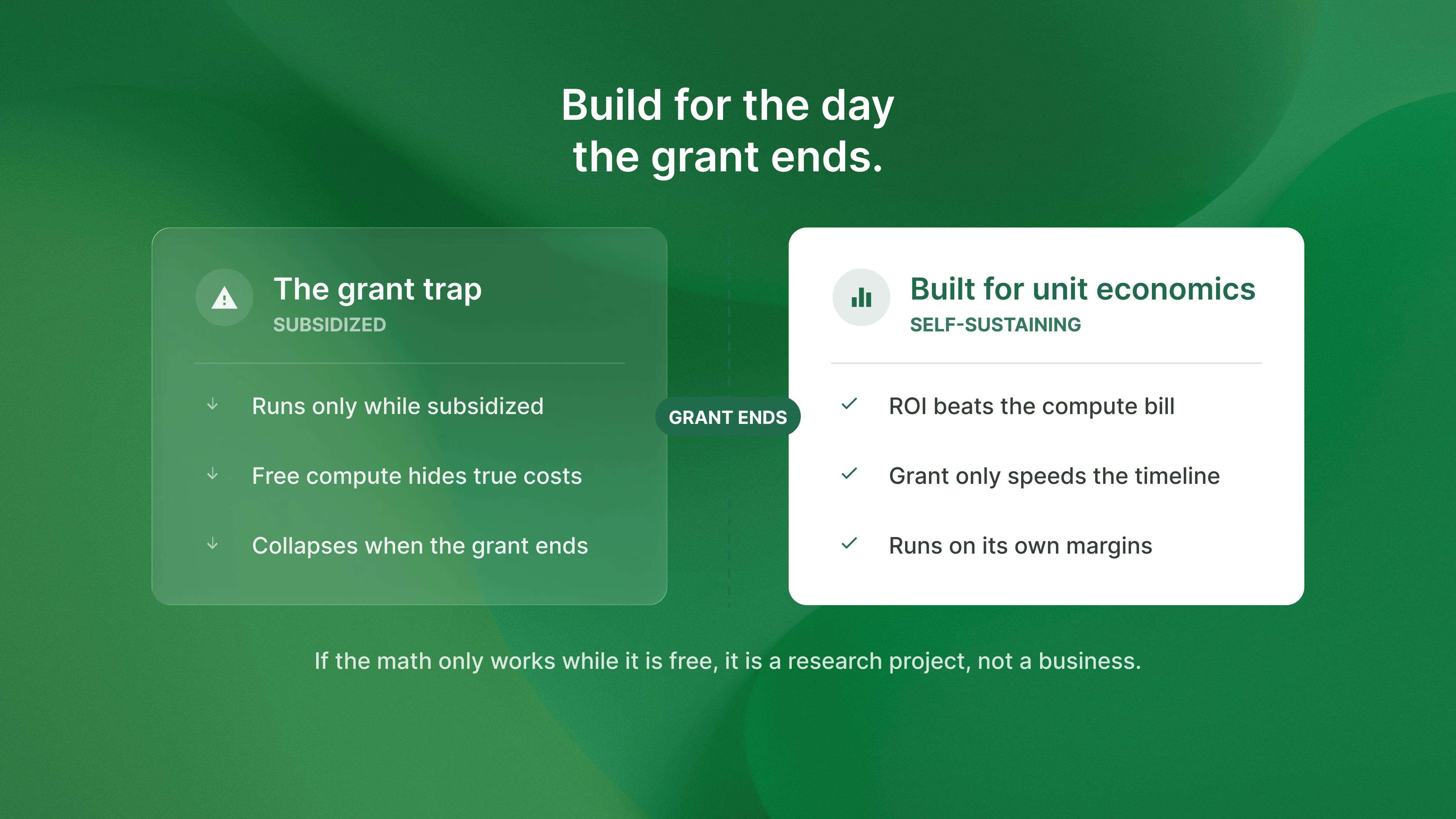
A common pitfall is the grant trap. This happens when a startup builds a system optimized for grant requirements rather than unit economics. A project may look successful on paper because compute was free. But it can fail in the real world when the grant ends. Then the true costs hit the balance sheet. You must build for unit economics from day one. Before choosing a development path, evaluate your technical infrastructure partner to avoid architectural debt.
Grants should fund the development of the engine, but the fuel must eventually be self-sustaining.
Friedrich List drew the same distinction in 1841, arguing against judging a nation by what it held rather than by what it could make:
“The power of producing wealth is infinitely more important than wealth itself.”
Friedrich List — The National System of Political Economy, 1841
His illustration was Spain, which grew enormously rich on American silver and declined anyway, because the money arrived without any matching capacity to produce. Germany was devastated repeatedly and recovered each time, because the productive capacity survived what the wealth did not.
Grant capital is silver. It appears in the bank account and then it runs out. What it should leave behind is an architecture that creates more value than it uses. That is the only thing still working when funding stops. This means focusing on automation efficiency that delivers enough value to cover its own infrastructure costs. The goal is to use the grant to reach the point where your AI agents are so efficient that their ROI exceeds their API and compute bills.
The bottom line
Treat grants as tools for capital efficiency, not a business model. Use the available 137 opportunities to build your technical bedrock. If you want to audit your infrastructure costs and see which grants apply to your current roadmap, let’s talk.
Build. Run. Maintain.
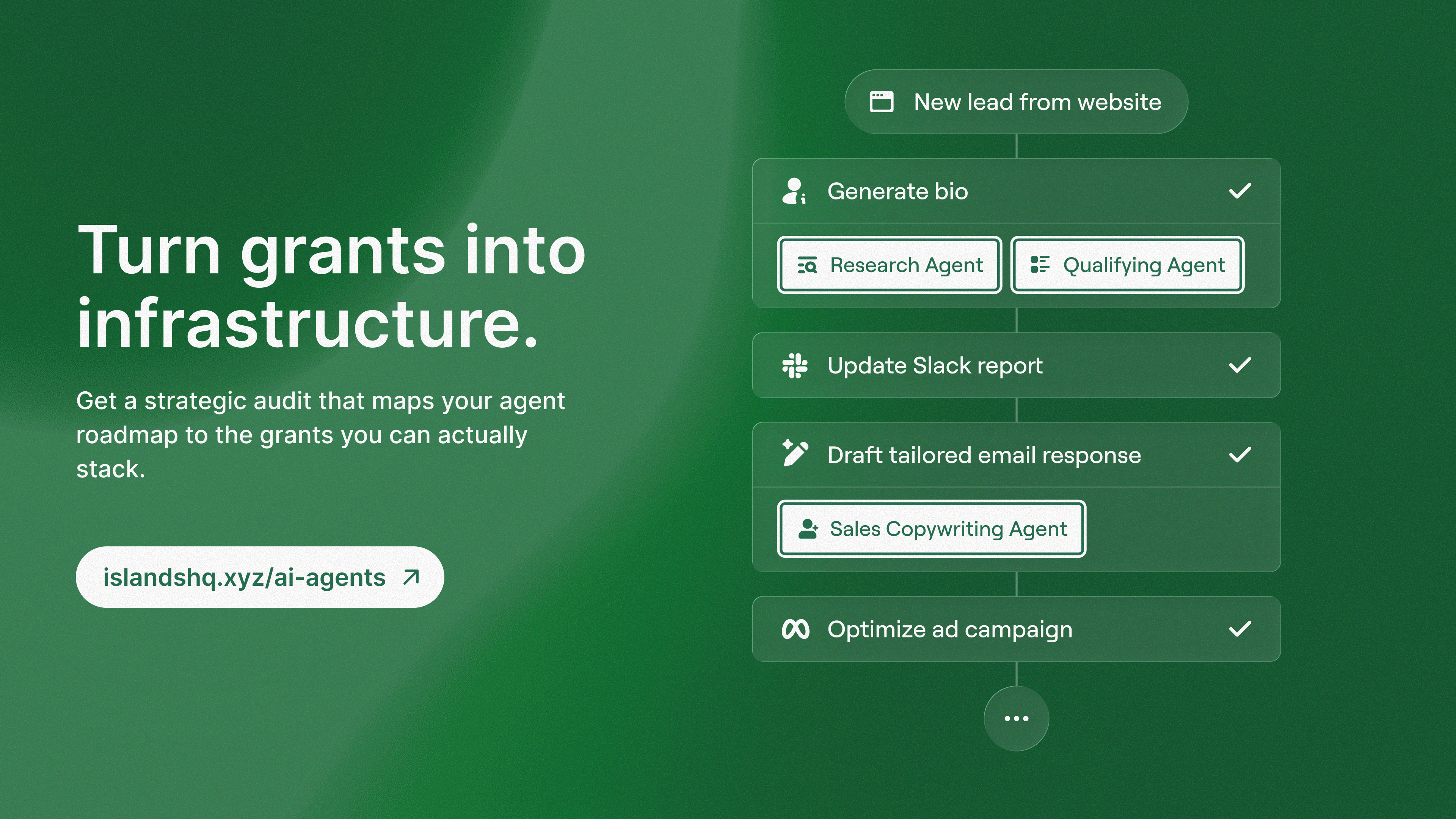
Are you currently using any of these funds to offset your GPU costs? Book a call for a strategic audit of your technical roadmap.