
A Series B founder recently shared how a generalist accountant missed nearly six figures in SR&ED credits. The issue was the narrative. They could not explain the technical uncertainty of their LLM fine-tuning to the CRA. This is a common and expensive mistake in the current AI market. While the program is a massive opportunity for Canadian startups, finding the right SR&ED tax credit consultant ensures your technical narrative holds up under scrutiny. The new era of compliance requires specialized technical expertise.
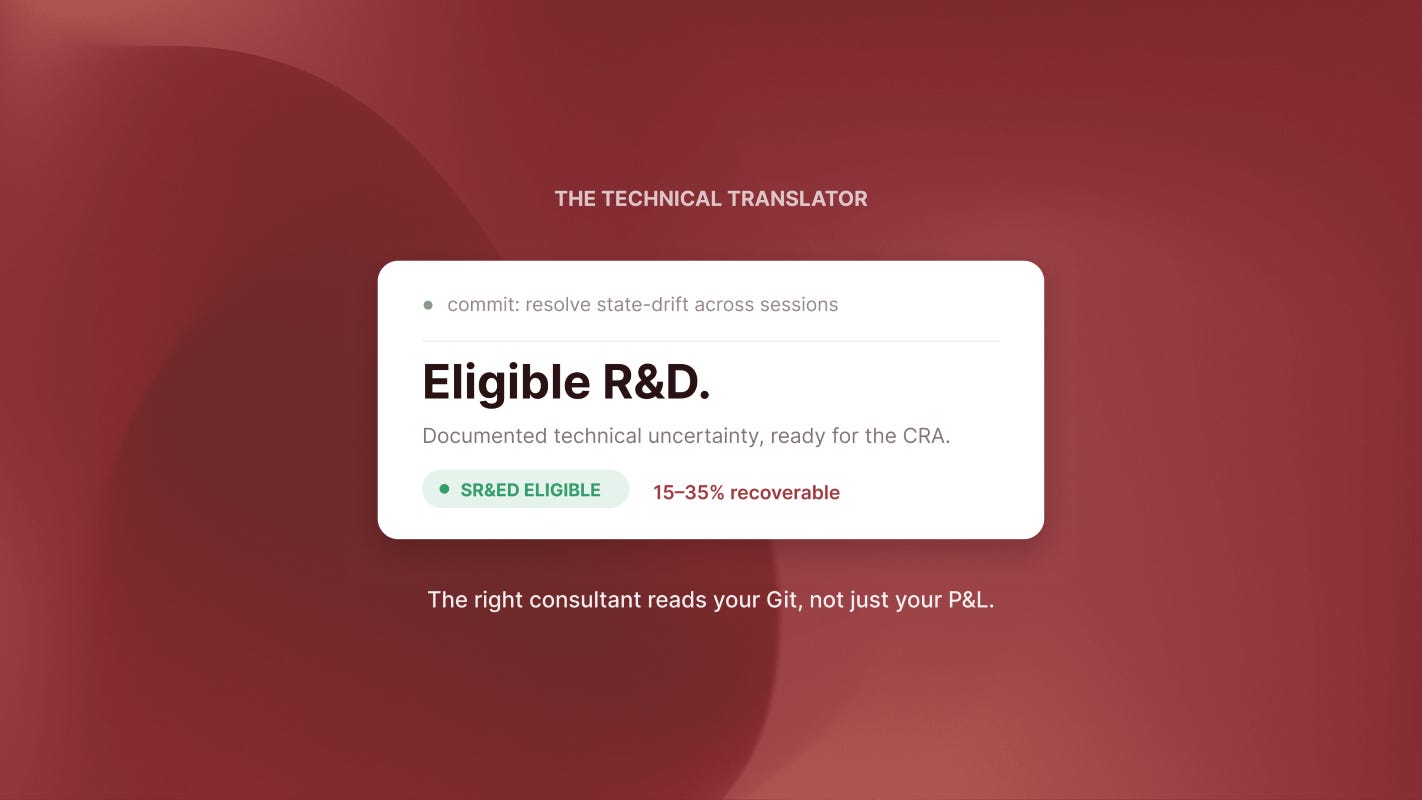
You need a partner who understands the difference between a wrapper and a production-grade autonomous system. The SR&ED program is the single largest provider of federal R&D support in Canada (Canada Revenue Agency), making the choice of consultant a high-stakes financial decision. If your consultant does not understand your code, they cannot defend your claim. You are looking for a technical translator.
Choosing an expert SR&ED tax credit consultant for AI R&D
SR&ED is your primary non-dilutive engine. For AI-native startups, it is the most reliable way to fund the engineering talent and compute required to build autonomous agentic systems. Expert guidance is essential to navigate the economic complexity of AI production, especially for software-heavy startups. A generalist accountant often defaults to safe, conservative claims because they lack the technical depth to argue why a specific architectural hurdle constitutes scientific uncertainty.
The cost of standard accounting errors includes significant audit risk. If a claim is phrased in marketing terms rather than technical ones, it flags the CRA for a review. You need someone who can sit down with your CTO and extract the actual engineering challenges rather than business outcomes. In a market where infrastructure scaling costs often exceed initial POC budgets, every dollar of recovery counts. These AI R&D tax incentives reward true innovation, but they require a rigorous evidence trail.
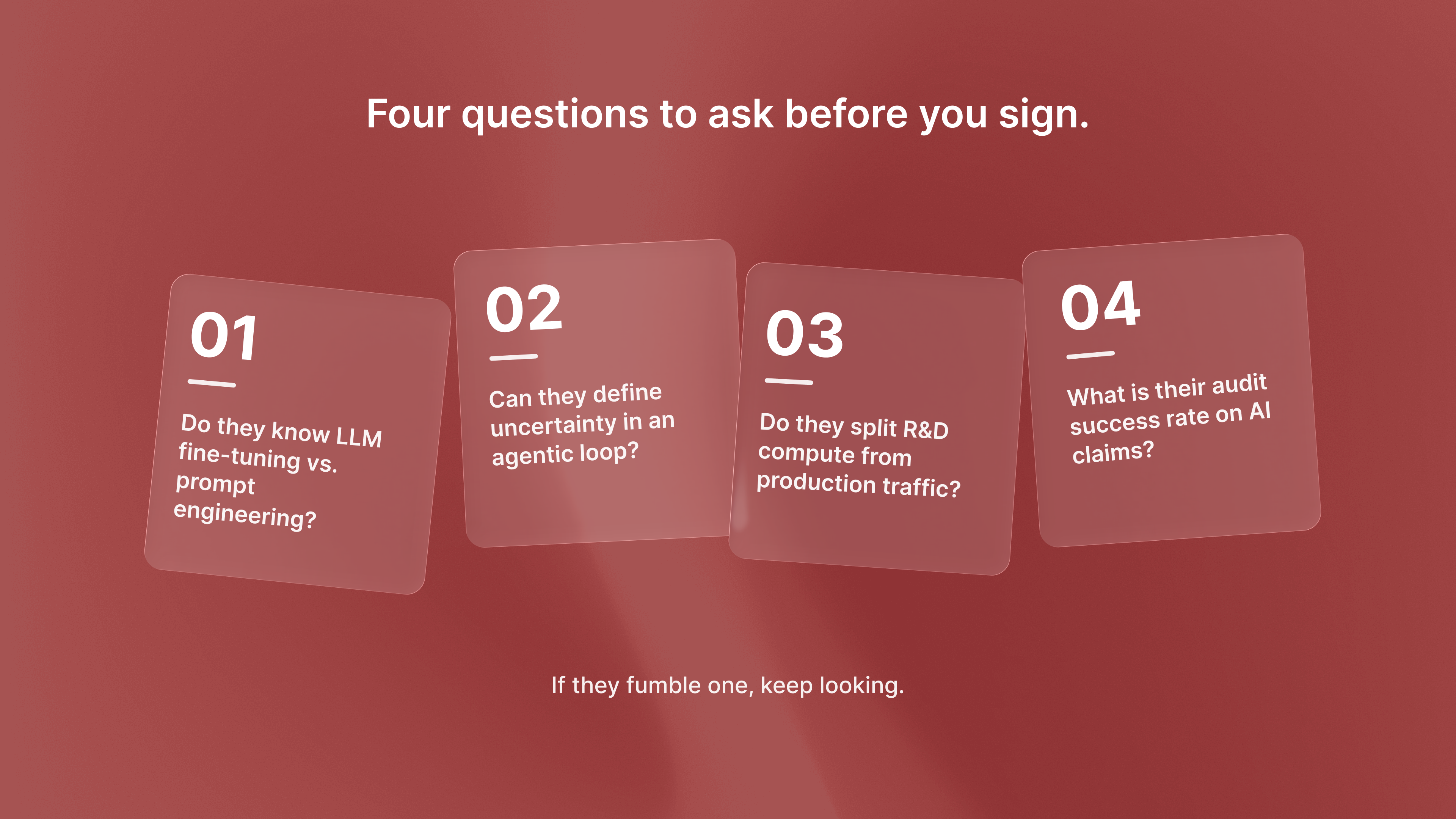
4 questions to ask a SR&ED tax credit consultant
When vetting a potential partner, you must push beyond their history of successful filings. You need to test their technical literacy in the context of modern AI development.
Do they understand the difference between LLM fine-tuning and prompt engineering? (Prompt engineering is rarely R&D; fine-tuning often is.)
Can they define technical uncertainty in an agentic loop? (They should discuss state management, orchestration, and non-deterministic outcomes.)
How do they handle compute costs in their calculations? (They should have a strategy for separating experimental compute from production compute.)
What is their process for interviewing engineering leads? (It should be a peer-to-peer technical deep dive, not a generic questionnaire.)
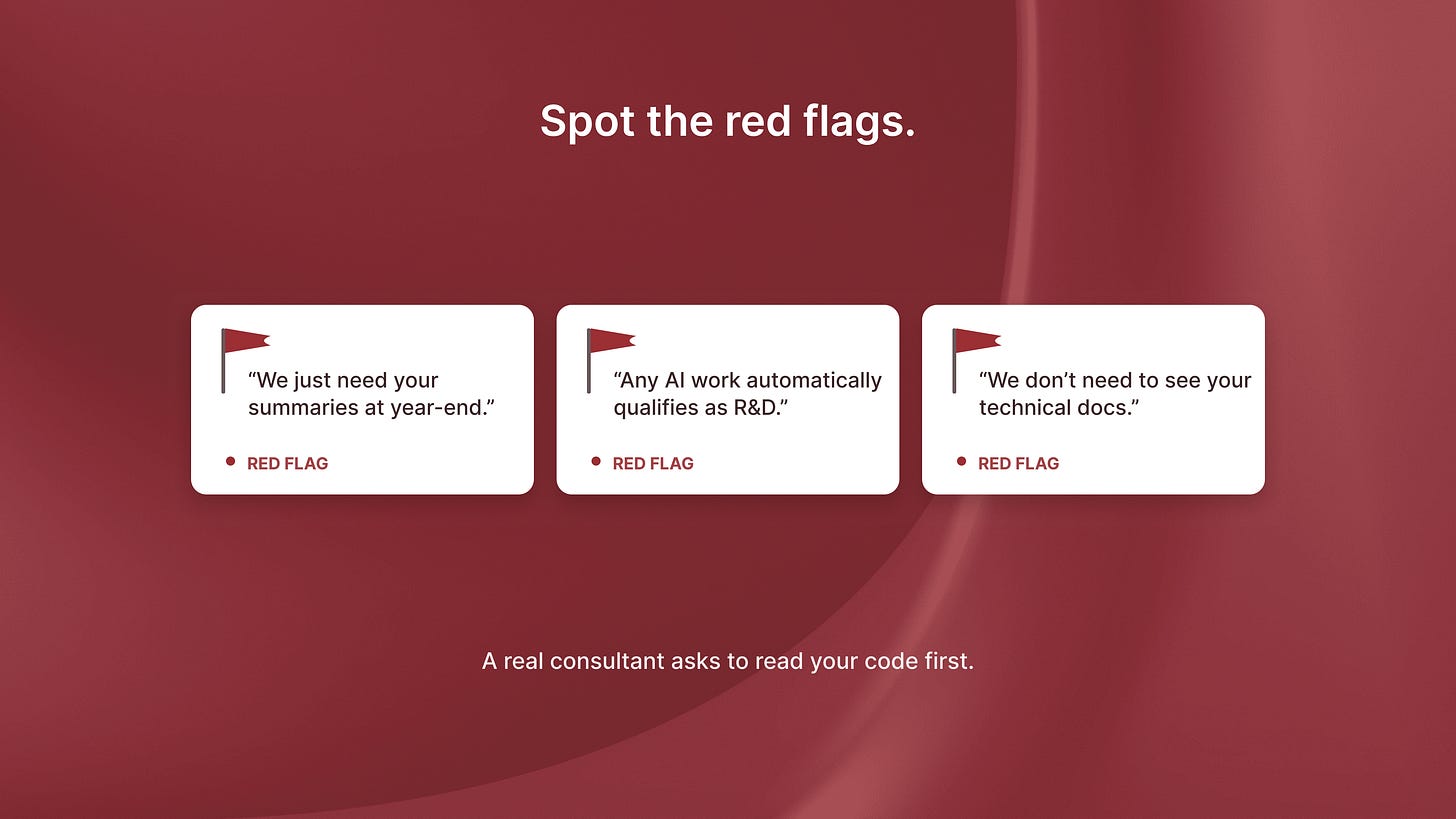
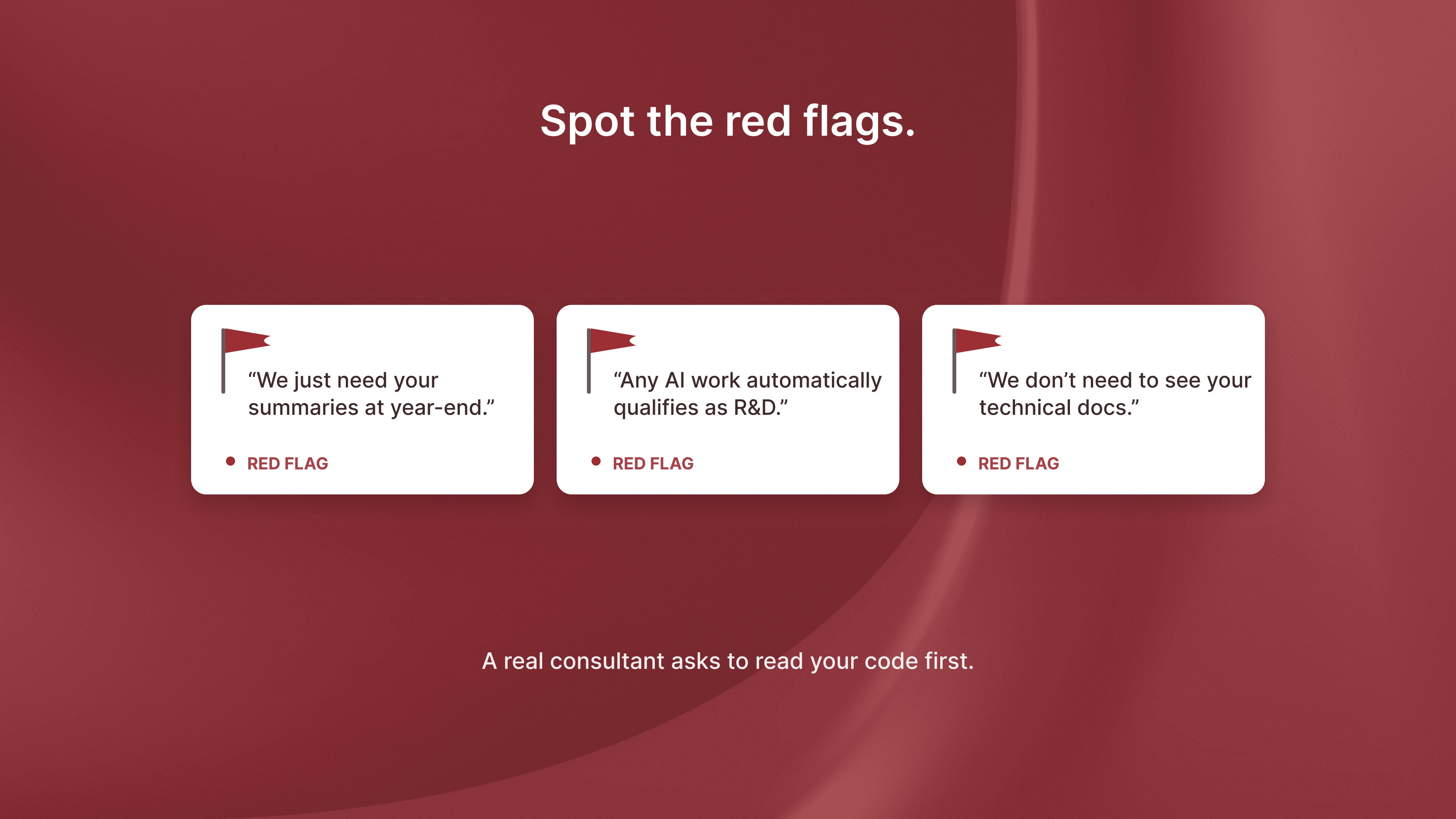
Watch out for red flag answers like “we just need your project summaries” or “we can claim everything regardless of the technical hurdle”. These types of responses indicate a lack of depth that will lead to a failed audit, especially when filing SR&ED for software development projects (KPMG).Documentation: the bridge between engineering and compliance
The secret to a high-yield SR&ED claim is what happens in Git every day. Your consultant should help you set up systems to capture R&D data in real-time. This reduces the burden on your engineers and ensures that the narratives you file are backed by contemporary evidence.
Capture R&D data in real-time through automated tagging in Jira or GitHub
Translate Git commits into technical narratives that highlight uncertainty
Maintain a failure log of architectural pivots that did not work
Separate R&D infrastructure spend from standard SaaS overhead
Auditing your current R&D strategy
If you are scaling a technical team in Canada, your SR&ED strategy is as important as your product roadmap. You need to ensure you are not leaving money on the table that could be used to hire senior engineers or expand your compute clusters. Maximizing Canadian startup tax credits can be the difference between hitting your next milestone and running out of runway. Many US-based firms are now leveraging Canadian talent through an EOR specifically to capture these R&D incentives while accessing lower-cost AI development talent.
Conduct a technical audit of your current R&D projects to identify missed opportunities
Interview your current consultant on their understanding of autonomous systems
Implement a standardized documentation process across all engineering squads
Benchmark your recovery percentage against other Series B AI startups in your sector
The bottom line
The right consultant acts as a technical translator. A lack of technical depth at the accounting level can drain your engineering budget. Infrastructure beats tools every time.
Build. Run. Maintain.
How much is your current reporting process costing your engineers in lost time? Reach out today to see how our technical audit can transform your unit economics by helping you book a call.