
I recently watched a Series B founder realize their 20-person content team was the biggest blocker to a global launch. They were not slow; they were manual. This founder tried to scale a 50,000-SKU catalog into three new languages. They used a traditional human-in-the-loop workflow. It was a classic architectural trap. They applied a linear solution to an exponential problem. In today’s market, using e-commerce AI tools to manage content is the best way to protect unit economics. Adding more headcount is no longer a viable path to growth.

Most brands treat AI as a glorified spell-checker. They use LLMs to polish product descriptions, but the underlying workflow remains manual. This creates a latency problem that kills expansion. If it takes your team six weeks to update a catalog, you are losing millions in potential revenue. Meanwhile, your competitors ship in days. The shift from simple assistants to autonomous agentic architecture is no longer optional for e-commerce scale-ups.
Bill Gates described this failure mode long before LLMs existed, in what he framed as the two rules of business technology. The first is the one everyone quotes. The second is the one that matters here:
“...automation applied to an inefficient operation will magnify the inefficiency.”
Bill Gates
Layering a language model over a manual approval chain does not remove the chain. It produces flawed drafts faster and moves the bottleneck downstream to the same people who were already the constraint.
Why e-commerce AI solutions are replacing manual management
The cost of human-in-the-loop latency is invisible until it becomes catastrophic. When you rely on people to manually verify every AI-generated description, you create a bottleneck. This prevents real-time updates. The brand voice drift problem becomes inevitable as you scale across multiple regions. Different teams interpret brand guidelines differently. This leads to a fragmented customer experience that confuses the algorithms.
AI-driven strategies are now essential for e-commerce brands to manage scale and drive leads efficiently (Position Digital). By adopting a comprehensive AI content strategy, you can ensure your messaging remains consistent across all touchpoints. Without a system that can autonomously maintain brand consistency, your catalog becomes a liability. You need a persistent memory layer. This ensures every piece of content sounds like your brand, regardless of the language.
The 5-step framework for autonomous content scaling
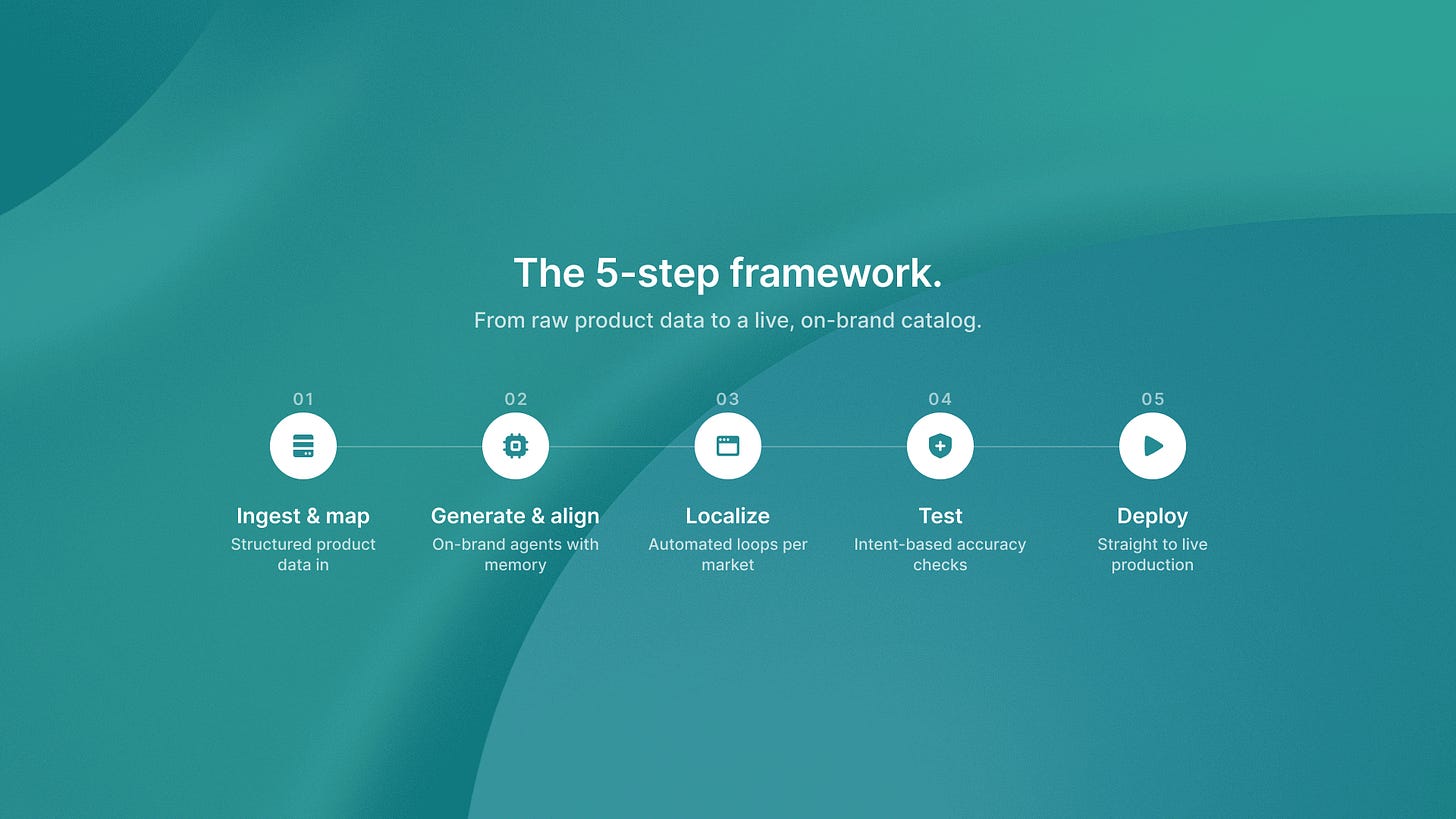
To move beyond the manual trap, technical leaders must implement an agentic architecture. This framework allows you to scale content without increasing your management tax. The steps include:
Ingestion and schema mapping to standardize raw product data from multiple sources.
Agentic generation where autonomous agents create high-intent descriptions aligned with your brand voice.
Product catalog automation loops that compress months of translation into weeks while maintaining cultural nuance.
Production-grade auditing uses autonomous intent-based testing through QA flow.
It ensures accuracy before content reaches the live catalog.Real-time optimization where agents update content based on performance data and search trends.
Moving from assistants to agents: the technical shift
The fundamental difference between an assistant and an agent is autonomy. An assistant waits for a prompt: an agent executes a workflow. Replacing entire workflows with e-commerce AI solutions is the only way to achieve true scale. You cannot enhance individual tasks. This requires moving away from simple API wrappers. Instead, build infrastructure that supports state management and persistent memory.
In my experience, startups must transition to autonomous agentic workflows to avoid the headcount trap. When you build agents that can plan and execute, you eliminate the middle-management bottlenecks that stall growth. This is how you achieve interaction parity across global markets without a massive increase in overhead.
Production-grade QA: ensuring reliability at scale
Scaling with AI requires a rigorous approach to quality. You cannot hope the model gets it right. You need a system that audits output for accuracy and brand alignment.
Donald Knuth ended a 1977 memo to a colleague with a caveat that has outlived the algorithm it described:
“I have only proved it correct, not tried it.”
Donald Knuth - memo to Peter van Emde Boas, March 1977
The distance between a system that should work and one that demonstrably does is where catalogs break. At 50,000 SKUs across three languages, that distance is not something you can close by spot-checking. Key takeaways for maintaining control include:
Implementing intent-based testing to verify that generated content meets specific business goals
Monitoring unit economics to ensure the cost of automation stays below the value it creates
Using persistent brand-voice memory to prevent drift across different product categories
Integrating autonomous systems like QA flow that can verify outputs without manual script generation to prevent scaling bottlenecks
What to do next: your 30-day implementation
Audit your current catalog workflow to identify where manual verification is slowing down production.
Identify a single product category to pilot an autonomous agentic generation system.
Measure the latency and cost-per-SKU of the pilot compared to your existing human-led process.
The bottom line
In a competitive market, speed is the only moat left for e-commerce giants. Moving from manual content creation to autonomous systems is the only way to scale without breaking your business model.
Build. Run. Maintain.
Are you ready to automate your catalog? Reach out to Islands to see how an agentic roadmap can accelerate your global launch.